- Posted on
- admin
- No Comments
OpenBao vs HashiCorp Vault
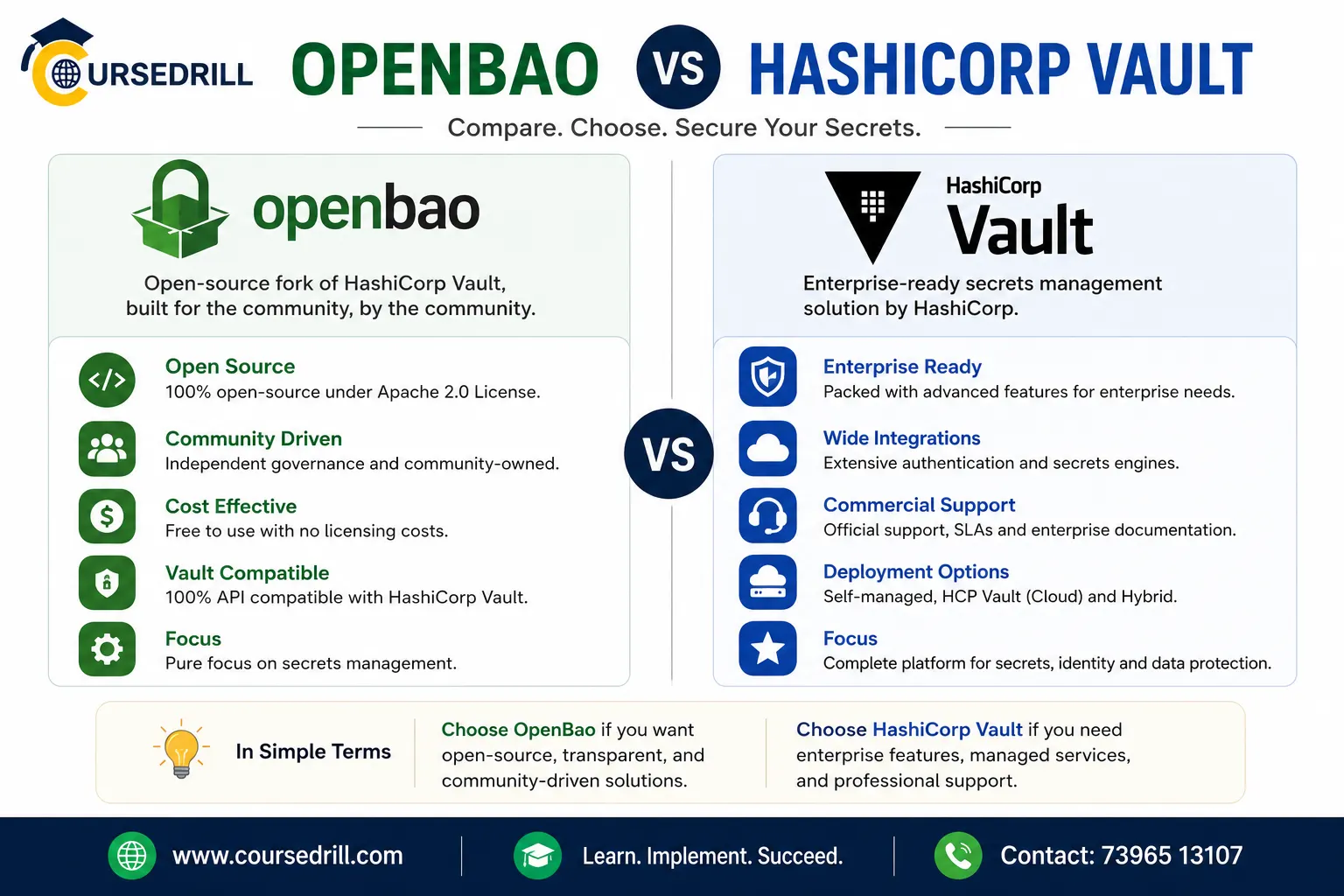
For most of the last decade, “secrets management” and “Vault” were basically synonyms. Then, in August 2023, HashiCorp changed the license on its open-source products, Vault included, from the permissive Mozilla Public License to the Business Source License. That single decision is the reason this comparison exists at all. OpenBao is the direct community response: a fork of Vault’s last MPL-licensed codebase, kept alive and developed in the open under Linux Foundation governance.
If you’ve already read our complete guide to what OpenBao is, you know the backstory. This piece goes narrower and deeper: a direct, feature-by-feature comparison of the two, covering licensing, architecture, namespaces, pricing, community size, and the practical question of which one actually deserves a spot in your infrastructure in 2026.
OpenBao vs Vault at a Glance
| OpenBao | Vault Community Edition | Vault Enterprise | |
|---|---|---|---|
| License | (cite index=”15-1″>MPL 2.0 (OSI-approved) | (cite index=”32-1″>Business Source License 1.1 | Commercial |
| Governance | (cite index=”15-1″>Linux Foundation | HashiCorp / IBM | HashiCorp / IBM |
| Forked from | (cite index=”9-1″>Vault 1.14.0, the last MPL release | — | — |
| Namespaces (multi-tenancy) | (cite index=”15-1″>Yes, included free | (cite index=”15-1″>No | Yes |
| Horizontal read scalability | (cite index=”15-1″>Yes (added v2.5.0) | (cite index=”15-1″>No, Enterprise only | Yes |
| Disaster recovery replication | (cite index=”15-1″>No, workaround required | No | Yes |
| Performance replication | (cite index=”15-1″>No | No | Yes |
| HSM integration | Limited | No | Yes |
| Dynamic secrets, PKI, KV, Kubernetes/AppRole/AWS/GCP auth | (cite index=”4-1″>Broadly API-compatible with Vault | Yes | Yes |
| GitHub stars (approx.) | (cite index=”15-1″>~5,400 | (cite index=”36-1″>~36,200 | — |
| Managed cloud offering | Community-hosted options only | (cite index=”20-1″>HCP Vault Dedicated | HCP Vault Dedicated / Enterprise |
| Pricing | Free | (cite index=”26-1″>Free self-hosted; HCP Vault Dedicated from ~$22/mo dev, $1,150–$6,900/mo production plus per-client fees | (cite index=”24-1″>Quote-only, commonly low six figures annually |
Why This Comparison Exists: The License Split
It’s worth restating plainly, because it explains every other row in that table. (cite index=”32-1″>Since August 2023, HashiCorp’s open-source products, including Vault, use the Business Source License 1.1, which permits internal and personal use, while enterprise features require a commercial license.
(cite index=”5-1″>BSL permits you to use, copy, modify, and redistribute Vault, including in production, under most circumstances, but you cannot offer Vault as a hosted or embedded service that competes directly with HashiCorp’s paid commercial offerings, and after four years from each release, the code converts to MPL 2.0.
For a huge number of companies just self-hosting Vault internally, that restriction changes nothing in day-to-day use. But BSL is not an OSI-approved open-source license, and for organizations with procurement policies requiring OSI-approved licensing, or for any company whose business model involves offering a hosted or embedded product built on top of Vault, the license itself became disqualifying overnight.
(cite index=”9-1″>Shortly after HashiCorp’s license change, the community forked Vault’s last MPL version, creating OpenBao as an open-source project under MPL 2.0 licensing and Linux Foundation governance.
Origins and Governance
(cite index=”15-1″>IBM engineers initiated the OpenBao project, though IBM has not made it an official corporate product. That’s a genuinely unusual detail worth sitting with for a second: (cite index=”28-1″>IBM completed its $6.4 billion acquisition of HashiCorp in February 2025, meaning IBM now has engineers connected to both sides of this comparison, the commercial original and the open fork that exists specifically because of a licensing decision made before IBM owned the company.
Governance is the structural difference that matters most here, more than any individual feature row. Vault’s roadmap, pricing, and licensing terms are ultimately HashiCorp’s, now IBM’s, to set. OpenBao’s governance sits with the Linux Foundation, a nonprofit structure explicitly designed to prevent any single company from unilaterally changing the terms on a project the community depends on, which is precisely the scenario that created OpenBao in the first place.
Feature Parity: Where the Two Are Nearly Identical
Set the license and governance questions aside for a moment, and the two projects behave almost the same way day to day. (cite index=”10-1″>OpenBao shares Vault’s API, command surface, secrets engines, and auth methods, and for the large majority of self-hosted secrets workloads, you would struggle to tell them apart in normal operation.
(cite index=”4-1″>For core functionality including KV v1/v2, PKI, database dynamic secrets, Kubernetes auth, AppRole auth, AWS auth, and GCP auth, OpenBao is broadly API-compatible with Vault OSS, and CLI commands and API paths follow the same conventions as Vault for commonly used workflows.
The barrier and seal/unseal model, Shamir key shares or auto-unseal via a cloud KMS, the four-stage authenticate/validate/authorize/access pipeline, dynamic database credentials with automatic lease expiration, all of it carries over directly, because OpenBao’s codebase literally is Vault’s codebase at the point of the fork, continuing to evolve independently from there.
If your evaluation criteria stop at “does it do the core job of a secrets manager,” the honest answer is that both do, equally well, for the overwhelming majority of use cases.
Where They Diverge: Namespaces
This is the single feature that gets cited more than any other in real-world OpenBao adoption decisions. (cite index=”15-1″>Namespaces, the feature that enables multi-tenancy and workload isolation between teams, are included in OpenBao’s free, open-source version, while HashiCorp reserves the equivalent capability for Vault Enterprise.
(cite index=”16-1″>The OpenBao project has added features of its own beyond what it inherited from Vault, including open-source namespaces for multi-tenancy, which remain an enterprise-only feature in Vault. For a platform team that wants to run one shared secrets management cluster and give each internal team, or each customer in a multi-tenant product, its own isolated slice of policies, secrets engines, and auth methods, this is often the deciding factor on its own. Getting the same capability out of Vault means paying for Enterprise, full stop, there’s no self-hosted, license-free path to it on the HashiCorp side.
(cite index=”15-1″>OpenBao also added horizontal read scalability as of version 2.5.0, another capability Vault reserves for its Enterprise tier, letting read-heavy workloads scale out across nodes without the licensing gate Vault applies to the same functionality.
Where Vault Still Leads: Enterprise-Grade Replication and HSM Support
It would be dishonest to frame this as OpenBao simply winning across the board, and the project’s own community doesn’t claim that either. (cite index=”10-1″>HashiCorp reserves its most advanced capabilities for Vault Enterprise, including performance and disaster-recovery replication, hardware security module integrations, and namespaces for multi-tenancy. OpenBao’s community has been building toward parity on several of these, but you should not assume an exact match, if your architecture depends on a specific Enterprise feature, verify OpenBao’s current support for it directly rather than treating the fork as feature-complete.
(cite index=”15-1″>Disaster recovery replication and performance replication both remain gaps on the OpenBao side, requiring workarounds rather than a built-in equivalent. For organizations running Vault Enterprise across multiple regions specifically for that active-active or DR replication capability, OpenBao is not yet a like-for-like substitute, and pretending otherwise does the comparison a disservice.
Ecosystem and Community Size
Vault’s head start shows up clearly here. (cite index=”36-1″>The hashicorp/vault repository sits at roughly 36,200 stars and 4,700 forks, reflecting over a decade as the de facto standard in the category. (cite index=”15-1″>OpenBao’s community has accumulated over 5,400 stars and 333 forks, a fraction of Vault’s footprint, though (cite index=”15-1″>the project is actively maintained, with commits landing regularly rather than showing signs of stalling.
What that gap means in practice: Vault has a vastly larger library of third-party integrations, Terraform providers, Kubernetes operators, community plugins, Stack Overflow answers, and consulting expertise built up over years. OpenBao inherits compatibility with much of that ecosystem by virtue of sharing Vault’s API surface, but purpose-built OpenBao tooling and community content is still comparatively thin. If you’re the kind of team that leans heavily on third-party integrations and community troubleshooting content, that gap is worth weighing seriously, even if the core software itself performs equivalently.
Pricing: Free vs. a Genuinely Complicated Cost Structure
OpenBao’s pricing story is simple: it’s free, in every deployment mode, with no tier gating core functionality behind a paywall. Vault’s pricing, by contrast, has gotten more complicated over time, not less.
(cite index=”26-1″>Vault Community Edition is completely free and provides core secrets management, encryption as a service, and identity-based access. Beyond that, (cite index=”26-1″>HCP Vault Dedicated starts at roughly $0.03 per hour, about $22 a month, for development-tier clusters, with production workloads requiring higher availability moving to plans around $1.58 per hour and up. (cite index=”22-1″>Production HCP Vault clusters commonly run $1,150 to $6,900 a month depending on size and tier, plus per-client charges starting around $112 per client per month, meaning a small production cluster with 25 clients can land around $3,500 a month before usage-based charges.
(cite index=”20-1″>HashiCorp does not publish Enterprise pricing at all, you have to talk to their sales team, and the final number depends on deployment size, client count, and compliance requirements. (cite index=”24-1″>Vault Enterprise self-managed requires sales engagement, but community reports suggest low six figures as a typical baseline, with (cite index=”24-1″>discounts of 30 to 50 percent standard in negotiation.
The product lineup has also been actively shrinking rather than expanding since the IBM acquisition. (cite index=”20-1″>HCP Vault Secrets, HashiCorp’s simpler SaaS-only secrets product, had its end-of-sale announced for June 30, 2025, with final end-of-life on July 1, 2026, pushing existing customers toward HCP Vault Dedicated or Vault Community Edition, both of which carry higher complexity and cost. (cite index=”20-1″>The HCP Vault Dedicated Starter tier was also discontinued around the same time.
For a small team evaluating cost alone, the comparison isn’t close: OpenBao costs nothing to license at any scale, while Vault’s genuinely useful managed and enterprise tiers come with real, sometimes opaque, dollar figures attached.
The IBM Acquisition’s Effect on Vault’s Direction
This is worth its own section, because it’s changed the calculus for teams evaluating Vault specifically, independent of the license question. (cite index=”28-1″>Since the acquisition closed in February 2025, community engagement and support response times have slowed as Vault becomes part of IBM’s broader hybrid cloud strategy, and the product lineup has been shrinking rather than growing. (cite index=”29-1″>The long-term roadmap is now being driven by IBM’s hybrid cloud strategy rather than HashiCorp operating as an independent company.
None of that means Vault is going away, it remains, by a wide margin, the most widely deployed tool in this category. But it’s a reasonable factor for a team doing a multi-year infrastructure bet to weigh: Vault’s roadmap now answers to a much larger organization’s strategic priorities, while OpenBao’s roadmap answers to an open community process under a governance model built specifically to avoid exactly this kind of single-vendor steering.
Security Posture
Both projects treat security patching seriously, which matters more in this category than almost any other software decision you’ll make. (cite index=”31-1″>HashiCorp actively patches Vault against newly disclosed vulnerabilities, with recent releases addressing issues like oversized authentication token headers that could enable denial-of-service attacks, alongside routine dependency updates fixing CVEs in underlying libraries. OpenBao, sharing much of the same underlying codebase and design, inherits the same general security posture and has its own active patching cadence through the Linux Foundation’s governance process, including its own vulnerability disclosure and response practices distinct from HashiCorp’s.
Neither project’s security history gives a clean, decisive edge to the other. What differs is who you’re trusting with the patching cadence and disclosure process, a single vendor with a commercial security team, or a community project under open governance. Reasonable security teams land on both sides of that tradeoff depending on their organization’s risk model.
Storage Backends and High Availability
Both projects handle durability and clustering the same way structurally, since this is architecture OpenBao inherited wholesale from Vault at the point of the fork. Data gets encrypted by the barrier before it ever reaches the storage backend, and both support integrated Raft storage as a self-contained clustering option that doesn’t require a separate coordination service like Consul or etcd sitting alongside it. Both also support external backends like PostgreSQL for teams that already run and operate a database cluster and would rather lean on that operational investment than stand up a dedicated Raft cluster.
Where this starts to diverge is at the edges. Vault Enterprise’s replication features, performance replication for horizontally scaling reads across regions, and disaster recovery replication for standby clusters that can be promoted during an outage, sit on top of this shared storage foundation but remain licensed capabilities. OpenBao’s community has been working toward its own version of horizontal scaling, landing read scalability in version 2.5.0, but full replication parity, particularly DR replication across geographically separate clusters, isn’t there yet.
If your high-availability requirements stop at “survive a node failure within one region,” both handle that comfortably on the open-source tier. If they extend to “survive a full regional outage with an automated failover to a standby cluster,” that’s currently a Vault Enterprise-shaped requirement.
Real-World Adoption Signals
Adoption patterns tell a story that’s easy to miss if you only look at feature comparison tables. Vault’s decade-plus head start means it’s deeply embedded in existing infrastructure at a huge number of companies, wired into CI/CD pipelines, Terraform modules, and internal tooling that would all need to be touched during any migration away from it. That inertia is a real cost, independent of which tool is technically better, and it’s a large part of why even teams uncomfortable with the BSL often stay on Vault rather than migrating.
OpenBao’s adoption story is younger and more concentrated among teams with a specific, articulable reason to move: a procurement policy requiring OSI-approved licensing, a need for free namespaces that Vault Enterprise would otherwise gate behind a six-figure contract, or a general discomfort with depending on a single vendor’s licensing terms after having just been burned by one.
That’s a narrower but more motivated adoption curve than “everyone defaults to Vault because that’s what the industry has always used,” and it’s part of why OpenBao’s growth, while starting from a much smaller base, has been described by independent trackers as outpacing Vault’s in relative terms even as the absolute gap remains wide.
Migration Considerations
Because OpenBao forked directly from Vault’s codebase, migrating existing Vault workloads over is closer to a careful cutover than a rebuild. (cite index=”4-1″>Core functionality, KV v1/v2, PKI, database dynamic secrets, and common auth methods, is broadly API-compatible, with CLI commands and API paths following the same conventions for commonly used workflows.
The honest caveats: (cite index=”10-1″>if your architecture depends on a specific Vault Enterprise feature, replication or a particular HSM integration among them, verify OpenBao’s current support for it directly rather than assuming the fork has reached parity, and niche community plugins built specifically against HashiCorp’s Vault may not have a maintained OpenBao equivalent yet.
The practical path most teams take is standing up OpenBao alongside an existing Vault deployment, migrating secrets, policies, and auth methods incrementally, and keeping Vault available as a fallback until the new deployment has proven itself under real production traffic.
When to Choose OpenBao
OpenBao tends to be the stronger choice when:
- Your organization has a hard requirement for OSI-approved open-source licensing, common in financial services, government, and other regulated sectors.
- You need namespace-based multi-tenancy but can’t justify the cost of Vault Enterprise purely to get it.
- You want to avoid ongoing exposure to a single commercial vendor’s licensing and roadmap decisions, particularly post-acquisition.
- You’re comfortable with community-driven maintenance rather than a vendor support contract with formal SLAs.
- Cost predictability matters more than ecosystem breadth, and your workload doesn’t depend on Vault Enterprise-only replication or HSM features.
When to Choose HashiCorp Vault
Vault remains the stronger choice when:
- You need commercial support with a contractual SLA, or your organization requires vendor accountability that a community project structurally can’t offer.
- You’re already invested in the broader Vault and Terraform ecosystem, with existing integrations, tooling, and in-house expertise built around it.
- Your architecture genuinely depends on Vault Enterprise features like performance or disaster-recovery replication, or specific HSM integrations that OpenBao hasn’t reached parity on.
- Your use of Vault is purely internal, with no plans to offer it as a hosted or embedded service, making the BSL’s core restriction functionally irrelevant to your situation.
- You want a fully managed cloud option, HCP Vault Dedicated, and are comfortable with its published pricing structure.
Frequently Asked Questions
Is OpenBao a fully compatible drop-in replacement for HashiCorp Vault? For most common workflows, yes, since OpenBao forked directly from Vault’s codebase and remains broadly API-compatible for core secrets engines and auth methods. Less common plugins, niche community integrations, and Vault Enterprise-only features should be verified individually rather than assumed to carry over.
Why did OpenBao get created in the first place? HashiCorp changed Vault’s open-source license from the permissive MPL 2.0 to the Business Source License in August 2023. Shortly after, the community forked Vault’s last MPL-licensed version to create OpenBao, keeping it under a fully open, OSI-approved license and Linux Foundation governance.
Does OpenBao really have namespaces for free? Yes. Namespaces for multi-tenancy are included in OpenBao’s open-source edition at no cost, while the equivalent capability in Vault is restricted to the paid Enterprise tier.
Is HashiCorp Vault still free to use? Vault Community Edition remains free to self-host under the Business Source License, which permits most internal and personal use. The BSL’s main restriction is against offering Vault as a hosted or embedded service that competes with HashiCorp’s own commercial offerings.
How much does Vault Enterprise cost? HashiCorp doesn’t publish Enterprise pricing publicly, it requires a sales conversation, and community-reported figures commonly land in the low six figures annually depending on deployment size, client count, and compliance requirements, with negotiated discounts often available.
Has the IBM acquisition changed how Vault is developed? Since IBM’s acquisition closed in February 2025, HashiCorp has discontinued some Vault Secrets and HCP Vault Dedicated tiers, and community response times have reportedly slowed as Vault’s roadmap folds into IBM’s broader hybrid cloud strategy.
Which one has the bigger community? Vault, by a wide margin. Its GitHub repository sits around 36,000 stars against OpenBao’s roughly 5,400, reflecting Vault’s decade-plus head start as the category’s de facto standard. OpenBao’s community is smaller but active and growing.
Can I run OpenBao and Vault side by side during a migration? Yes, and it’s the recommended approach for most teams migrating. Standing up OpenBao alongside an existing Vault deployment, moving secrets and policies over incrementally, and keeping Vault as a fallback until the new deployment is proven reduces the risk inherent in cutting over a security-critical system all at once.
Final Verdict
Feature for feature, on the core job of storing and generating secrets securely, OpenBao and Vault are close enough that the choice rarely comes down to raw capability. It comes down to what you’re actually optimizing for. If licensing purity, free namespaces, and independence from a single commercial vendor’s roadmap matter most to your organization, OpenBao is a mature, production-ready choice backed by real Linux Foundation governance, not an experimental side project. If you need enterprise-grade replication, HSM integration, a large existing ecosystem, or a commercial support contract with a defined SLA, Vault, particularly Vault Enterprise, still leads, and that lead is unlikely to close overnight.
For the deeper architectural breakdown of how OpenBao itself works under the hood, our complete OpenBao guide covers the barrier, seal/unseal mechanics, and secrets engines in detail. And for the authoritative, up-to-date reference on OpenBao’s own roadmap and feature parity claims, OpenBao’s official documentation is the best place to verify anything mentioned here before making an infrastructure decision around it.
For more breakdowns of open-source infrastructure and DevOps security tooling like this one, keep exploring the guides on CourseDrill.
Popular Courses