- Posted on
- admin
- No Comments
Infisical vs HashiCorp Vault
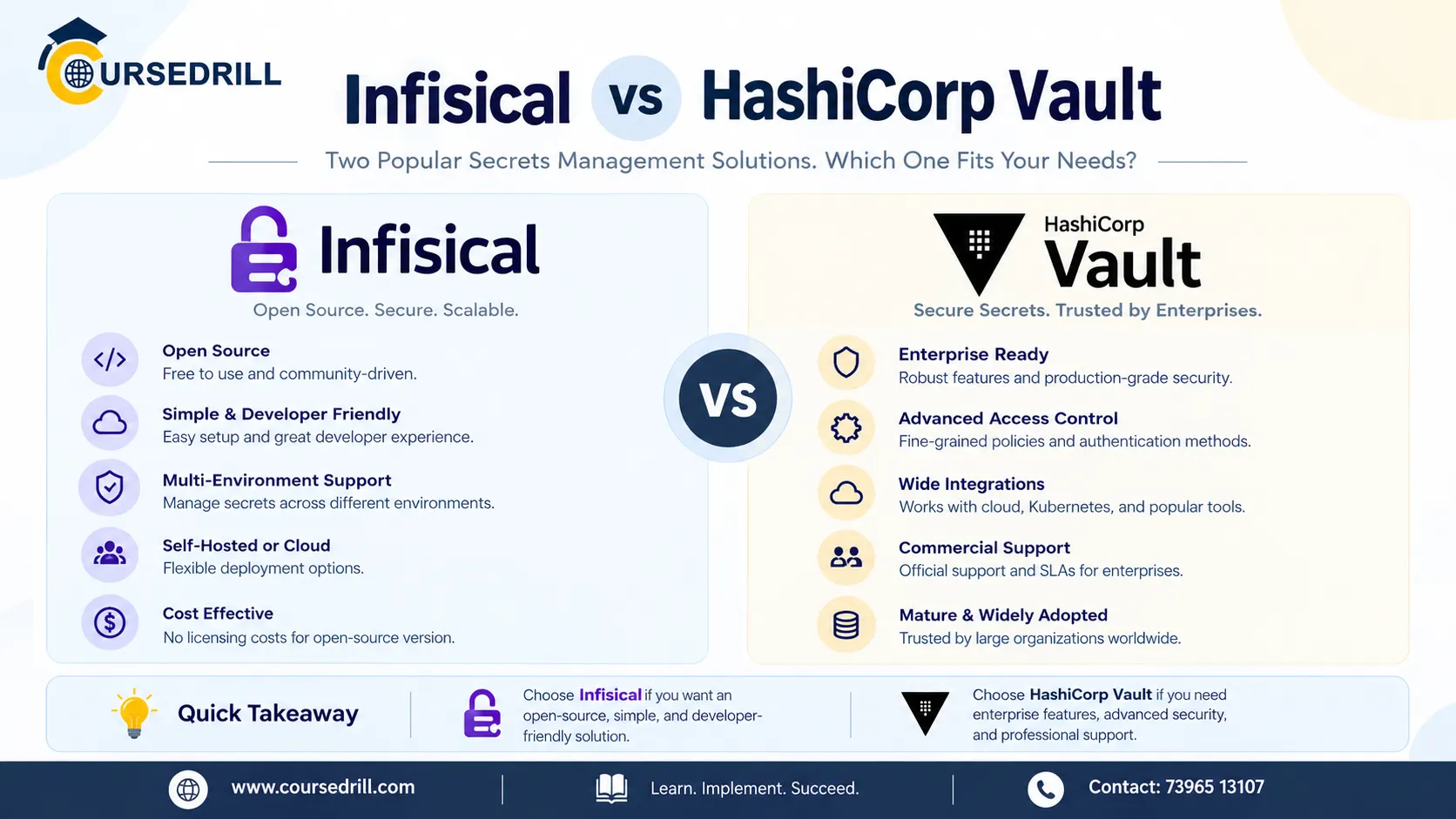
Every team that outgrows .env files eventually lands on this exact comparison. HashiCorp Vault has been the reference implementation for secrets management for over a decade, deep enough to do almost anything, complicated enough that “almost anything” comes with a real operational cost. Infisical showed up years later with a different bet entirely:
that most teams don’t need Vault’s full depth, they need something secure that developers will actually enjoy using, and they’d rather not run a small distributed systems project just to store an API key.
Neither bet is wrong. This comparison covers where Infisical and Vault genuinely differ, licensing, architecture, feature depth, pricing, and compliance, so you can figure out which philosophy actually matches what your team needs, rather than picking the more familiar name by default.
Infisical vs Vault at a Glance
| Infisical | HashiCorp Vault | |
|---|---|---|
| Core philosophy | (cite index=”20-1″>Security through simplicity | (cite index=”20-1″>Building blocks: flexible primitives, more setup required |
| License (core) | (cite index=”26-1″>MIT, OSI-approved, no usage restriction | (cite index=”26-1″>Business Source License (BUSL-1.1), not OSI-approved |
| Enterprise features | (cite index=”26-1″>Source-available in an /ee directory, commercial license to run | Commercial Enterprise edition |
| Learning curve | (cite index=”25-1″>Easy | (cite index=”25-1″>Steep |
| Encryption model | Client-side, end-to-end (“blind backend”) | Server-side barrier encryption |
| Dynamic secrets engines | (cite index=”20-1″>AWS, Azure, GCP, AliCloud, LDAP, RabbitMQ, Kubernetes, SSH, TOTP | (cite index=”20-1″>Broad coverage plus HashiCorp-ecosystem-specific engines (Consul, Nomad, HCP Terraform) |
| Session/PAM recording | (cite index=”20-1″>Broader session recording as part of the core platform | Limited, more focused on secrets than session access |
| Deployment | (cite index=”19-1″>Self-hosting for complete data control, or managed cloud | Self-hosted, or HCP Vault Dedicated managed cloud |
| Starting price | (cite index=”21-1″>Infisical Cloud Pro from about $8 per user/month | (cite index=”22-1″>HCP Vault Dedicated from about $0.03/hour (~$22/month) for dev tier |
| GitHub stars (approx.) | (cite index=”10-1″>~25,700 | (cite index=”36-1″>~36,200 |
Two Different Philosophies
The clearest way to understand this comparison is to start with how each project describes its own design intent, because the rest of the comparison mostly falls out of that starting point.
(cite index=”20-1″>HashiCorp Vault follows a “building blocks” philosophy, offering flexible primitives for secrets management, identity-based access, and dynamic secrets. Vault can accommodate complex use cases, but that flexibility comes with real trade-offs: assembling a complete secrets management system requires substantial effort to develop custom workflows, integrations, plugins, and dashboards, leading to high setup costs and an ongoing maintenance burden.
Vault’s learning curve for managing secrets, policies, authentication, and sealing can also make it difficult for developers to use effectively, and when tools are hard to use, teams often develop workarounds, workarounds that can introduce the very risks the tool was meant to eliminate.
(cite index=”20-1″>Infisical takes a different approach: security through simplicity. Rather than giving you primitives to assemble your own system, it ships as a more complete, opinionated product out of the box, dashboard, CLI, integrations, and encryption model included, with less assembly required to get to a working setup.
Neither framing is purely marketing. Vault’s flexibility genuinely is why large, complex organizations with dedicated platform teams still reach for it. Infisical’s simplicity genuinely is why smaller, faster-moving teams without a dedicated security engineer on staff tend to prefer it. The philosophy difference is real, and it’s worth being honest with yourself about which side of that tradeoff your team actually sits on before choosing based on feature checklists alone.
Licensing: Two Different Kinds of “Open”
Both projects describe themselves as open source, and both are, in a meaningfully limited sense, worth spelling out precisely rather than taking either marketing page at face value.
(cite index=”26-1″>Infisical’s core is MIT, an OSI-approved license with no usage restriction, while its enterprise features live in a source-available /ee directory. That makes Infisical an open-core project: the core is genuinely open, and the enterprise tier is source-available rather than fully open. (cite index=”26-1″>Vault is different. HashiCorp relicensed it under the Business Source License (BUSL-1.1) in August 2023, and BUSL is not an OSI-approved open-source license. HashiCorp is now an IBM company, with the acquisition completing in early 2025.
(cite index=”26-1″>For teams to whom an OSI-approved core specifically matters, Infisical’s MIT core is the more open option of the two. But for teams to whom the license is more academic, because they simply run the software in production and never hit a restriction either license imposes, this isn’t the deciding factor, capability is. It’s also worth being precise about a detail that’s easy to gloss over:
(cite index=”26-1″>if an OSI-approved license across the entire product is the hard requirement, neither project fully clears that bar. Infisical keeps enterprise features in its /ee directory under a separate license, and the fully OSI-licensed path on the Vault side isn’t Vault itself, it’s OpenBao, the MPL-2.0, Linux Foundation-governed fork. If pure open-source licensing across the whole stack is genuinely non-negotiable for your organization, it’s worth reading our OpenBao vs HashiCorp Vault comparison alongside this one, since neither Infisical nor Vault itself is the answer to that specific requirement.
Architecture: Client-Side Encryption vs the Barrier
This is where the two products diverge most concretely at a technical level, and it’s a genuine architectural difference, not just a feature checkbox.
Infisical’s defining architectural choice is client-side, end-to-end encryption, sometimes described as a “blind backend.” Secrets get encrypted on the user’s device, browser or CLI, before they’re ever transmitted to Infisical’s servers, using AES-256-GCM. The server only ever stores ciphertext and structurally cannot decrypt it without the workspace key derived from the user’s own credentials. Even a full database compromise on Infisical’s side wouldn’t expose usable plaintext secrets.
Vault’s model works differently, though it aims at a related goal through a different mechanism. Vault encrypts data through what it calls the barrier before writing anything to its storage backend, treating that backend as untrusted. The distinction that matters: Vault’s server-side process holds and manages the encryption keys (behind the seal/unseal mechanism),
whereas Infisical’s architecture is designed so the server-side never needs to hold a usable key at all. Both approaches protect data from a compromised storage backend. Infisical’s approach additionally aims to protect data from a compromised Infisical server itself, a narrower and more specific threat model that Vault’s architecture doesn’t target in quite the same way.
Which of these matters more to you depends on your actual threat model. If you’re mainly worried about someone stealing your database backup, both architectures handle that well. If you’re specifically worried about the secrets provider’s own infrastructure being compromised, Infisical’s client-side model is a structurally stronger guarantee, by design, at the cost of some flexibility elsewhere, since a server that genuinely cannot read your secrets also can’t offer certain server-side conveniences that require reading them.
Feature Depth: Where Vault Still Has More Room to Grow Into
It’s tempting, given Infisical’s developer-experience advantage, to assume it’s caught up to Vault everywhere. It hasn’t, and honest comparisons say so directly.
(cite index=”21-1″>The platform has not yet matched Vault’s dynamic secrets breadth, but for organizations whose rotation requirements are met by automated static credential rotation, the gap is functional rather than architectural. In plainer terms: if what you need is “rotate this database password automatically on a schedule,” Infisical covers that comfortably.
If what you need is Vault’s deeper leasing model, dynamically generated, narrowly scoped credentials for a huge range of systems with fine-grained TTL and revocation semantics, Vault’s implementation is simply more mature and more broadly extensible.
(cite index=”20-1″>Vault offers separate secrets engines for AWS, Azure, GCP, AliCloud, LDAP, RabbitMQ, Kubernetes, SSH, and TOTP, with some engines specific to the wider HashiCorp ecosystem like Consul, Nomad, and HCP Terraform. Both platforms offer broad dynamic secrets coverage with comparable engines for the most common systems, but Vault’s plugin ecosystem, built over a decade, extends further into niche and enterprise-specific systems than Infisical’s newer implementation currently reaches.
(cite index=”26-1″>If your job is primarily dev-team secret syncing and you value ergonomics and a gentle learning curve, Infisical is the faster, more pleasant path to adopt. If you need deep dynamic secrets and leasing, the widest auth-method and secrets-engine ecosystem, or Enterprise features like replication and HSM integration, and you can absorb the operational weight that comes with them, Vault remains the deeper, more mature choice.
Where Infisical Pulls Ahead
It’s not a one-directional gap, though. Infisical has capabilities baked into its core product that Vault either doesn’t offer natively or reserves for a much more complex setup.
(cite index=”20-1″>Infisical includes PAM-style session recording with broader coverage as part of the core platform, compared to narrower session recording in some competing self-hosted access tools that only cover SSH sessions and no database query recording. Combined with PKI and SSH certificate management under the same roof, Infisical positions itself less as “just a secrets vault” and more as a unified secrets-and-access platform, whereas Vault’s PKI and SSH capabilities exist but require more manual assembly to wire together into an equivalent workflow.
Migration flexibility is another area worth calling out specifically, because it’s a genuinely clever detail in how Infisical positions itself against Vault rather than simply against it. (cite index=”20-1″>Infisical’s Secret Sync feature can push secrets directly to HashiCorp Vault, enabling a gradual, low-risk migration: teams can run Infisical alongside an existing Vault deployment, sync secrets from Infisical to Vault so existing applications keep working unmodified, migrate applications one at a time to pull from Infisical directly instead of a big-bang cutover, and decommission Vault infrastructure at their own pace once everything has moved over.
That’s a materially lower-risk path than most vendor-vs-vendor migrations offer, and it’s worth knowing about if switching away from an existing Vault deployment is actually on your roadmap rather than a greenfield decision.
Pricing Comparison
Cost structures differ enough between the two that a like-for-like number is hard to pin down without knowing your specific usage pattern, but the shape of each is clear.
(cite index=”21-1″>Infisical Cloud’s managed Pro tier starts at around $8 per user per month, though as covered in our complete guide to Infisical, published identity-based pricing on the current plan structure runs closer to $18 per identity per month, counting both human and machine identities, so it’s worth checking Infisical’s current pricing page directly for the exact figure applicable to your team size and automation footprint before budgeting.
On the Vault side, (cite index=”22-1″>HCP Vault Dedicated starts at roughly $0.03 an hour, about $22 a month, for development-tier clusters, with production-grade clusters running considerably higher once high availability and per-client charges are factored in, and Vault Enterprise’s self-managed pricing requiring a direct sales conversation rather than a published number.
Both platforms offer a genuinely free self-hosted path for their open-source core, so for a team with the operational capacity to run either one themselves, the license cost difference disappears entirely, and the real cost comparison becomes engineering time: how many hours does your team spend configuring and maintaining Vault’s building blocks versus adopting Infisical’s more assembled defaults.
Compliance and Certifications
For regulated industries, this is often a gating question before feature depth even enters the conversation. (cite index=”25-1″>Infisical supports SOC 2, GDPR, HIPAA, and PCI-DSS, and HashiCorp Vault supports the same set: SOC 2, GDPR, HIPAA, and PCI-DSS. On paper, the compliance checklist looks nearly identical between the two, though it’s worth verifying current certification status directly with each vendor before treating either as a settled requirement, certifications and their scope can shift, and self-hosted deployments inherit compliance obligations differently than a vendor’s managed cloud offering does.
Community and Ecosystem
Vault’s decade-plus head start shows clearly here. (cite index=”36-1″>The hashicorp/vault repository sits at roughly 36,200 GitHub stars, reflecting years as the default answer in this category, with a correspondingly large body of third-party integrations, Terraform providers, and community troubleshooting content built up over that time. (cite index=”10-1″>Infisical’s repository has grown past 25,700 stars, a smaller but rapidly growing footprint that reflects a younger project still building out its surrounding ecosystem rather than one with a decade of accumulated tooling behind it.
That gap matters most in the long tail, obscure integrations, edge-case Stack Overflow answers, consultants who’ve seen a specific failure mode before. For the core, common workflows both products are built around, the gap is far less consequential day to day.
Deployment Options
(cite index=”19-1″>Infisical provides self-hosting options for complete data control and customization, while Vault may require different deployment approaches depending on whether you’re running the open-source Community Edition yourself or using HashiCorp’s managed offerings. In practice, both support self-hosted and managed-cloud paths, Infisical via Docker Compose or Helm for self-hosting and Infisical Cloud for managed, Vault via its own binary or Helm chart for self-hosting and HCP Vault Dedicated for managed.
Neither forces you into a single deployment model, and the actual decision usually comes down to which one your team finds easier to operate at your current scale, which circles back to the ergonomics-versus-depth tradeoff that defines this whole comparison.
When to Choose Infisical
Infisical tends to be the stronger choice when:
- Your team wants a fast, pleasant path to secure secrets management without assembling custom workflows around raw primitives.
- You value client-side, end-to-end encryption specifically, where the provider’s own servers structurally cannot read your secrets.
- Your rotation and dynamic-secrets needs are met by automated static credential rotation rather than requiring Vault’s deepest leasing model.
- You want built-in PKI, SSH certificate management, and session recording without wiring together several separate tools.
- You’re planning a gradual migration away from an existing Vault deployment and want a lower-risk cutover path.
When to Choose HashiCorp Vault
Vault remains the stronger choice when:
- You need the deepest, most mature dynamic secrets and leasing model available in this category, or the widest possible auth-method and secrets-engine coverage.
- Your organization requires Enterprise-grade replication or HSM integration and has the operational capacity to run Vault properly.
- You’re already invested in the broader HashiCorp ecosystem, Terraform, Consul, Nomad, and want secrets management that integrates natively with tools you already run.
- Commercial support with a contractual SLA from an established vendor matters more than a gentler learning curve.
- Your team already has the platform engineering expertise to absorb Vault’s operational complexity without it becoming a maintenance burden.
Frequently Asked Questions
Is Infisical a good replacement for HashiCorp Vault? For teams whose secrets management needs are met by automated rotation, dynamic secrets for common systems, and a simpler day-to-day workflow, yes, many teams describe it that way. For organizations needing Vault’s deepest leasing model, the widest plugin ecosystem, or Enterprise-only replication and HSM features, Vault still leads on raw depth.
Which one has a more open license? Infisical’s core is MIT-licensed, an OSI-approved license with no usage restriction, while Vault’s core moved to the Business Source License in 2023, which is not OSI-approved. Neither product’s full stack is entirely open source, though, since Infisical’s enterprise features sit under a separate source-available license too. OpenBao is the option that keeps the entire stack under an OSI-approved license.
Does Infisical support dynamic secrets the same way Vault does? Both support dynamic secrets for common systems like AWS, GCP, Azure, and databases, but Vault’s leasing model and secrets engine ecosystem, built over a decade, remains broader and more mature than Infisical’s current implementation.
Can I migrate from Vault to Infisical without a risky cutover? Yes, Infisical’s Secret Sync feature can push secrets to an existing Vault deployment, letting you run both in parallel, migrate applications one at a time, and decommission Vault once everything has moved over, rather than requiring a single high-risk migration event.
Which one is easier to learn? Infisical, generally. Reviewers consistently describe Infisical’s learning curve as easy and Vault’s as steep, largely because Vault’s building-blocks philosophy requires assembling policies, auth methods, and sealing behavior yourself, while Infisical ships a more complete, opinionated product out of the box.
Are both compliant with SOC 2, HIPAA, and PCI-DSS? Both list support for SOC 2, GDPR, HIPAA, and PCI-DSS, though it’s worth confirming current certification scope directly with each vendor rather than treating either as settled, particularly for self-hosted deployments where compliance obligations are shared between the vendor and your own infrastructure.
Is Infisical cheaper than Vault? It depends heavily on usage. Infisical’s managed cloud pricing starts lower on paper, but its identity-based billing means machine identities, CI pipelines, and service accounts add to the cost the same way human seats do. Vault’s HCP Dedicated pricing starts even lower for small development clusters but scales up significantly for production, high-availability workloads. Both offer free self-hosting for their open-source core, at which point the real cost comparison shifts to engineering time rather than license fees.
Final Verdict
This comparison rarely comes down to one platform being objectively better, it comes down to which side of the simplicity-versus-depth tradeoff actually matches your team. Infisical is the stronger pick when you want secure secrets management that developers will actually enjoy using, with client-side encryption and a gentle learning curve, and your rotation needs don’t require Vault’s deepest leasing capabilities. Vault remains the stronger pick when you need the broadest possible feature depth, are willing to invest the engineering time its building-blocks philosophy demands, and your organization has the platform expertise to run it well.
If you’re still undecided, the Secret Sync migration path is worth remembering: choosing Infisical today doesn’t have to mean an irreversible bet against Vault, and vice versa, both can coexist during an evaluation period without forcing a single all-or-nothing decision upfront. For the deeper architectural breakdown of how Infisical’s own encryption model works, our complete Infisical guide covers that in detail, and for the authoritative reference on either platform, Infisical’s own comparison page is worth reading directly alongside this one for the vendor’s framing of the same tradeoffs.
For more breakdowns of open-source infrastructure and DevOps security tooling like this one, keep exploring the guides on CourseDrill.
Popular Courses