- Posted on
- admin
- No Comments
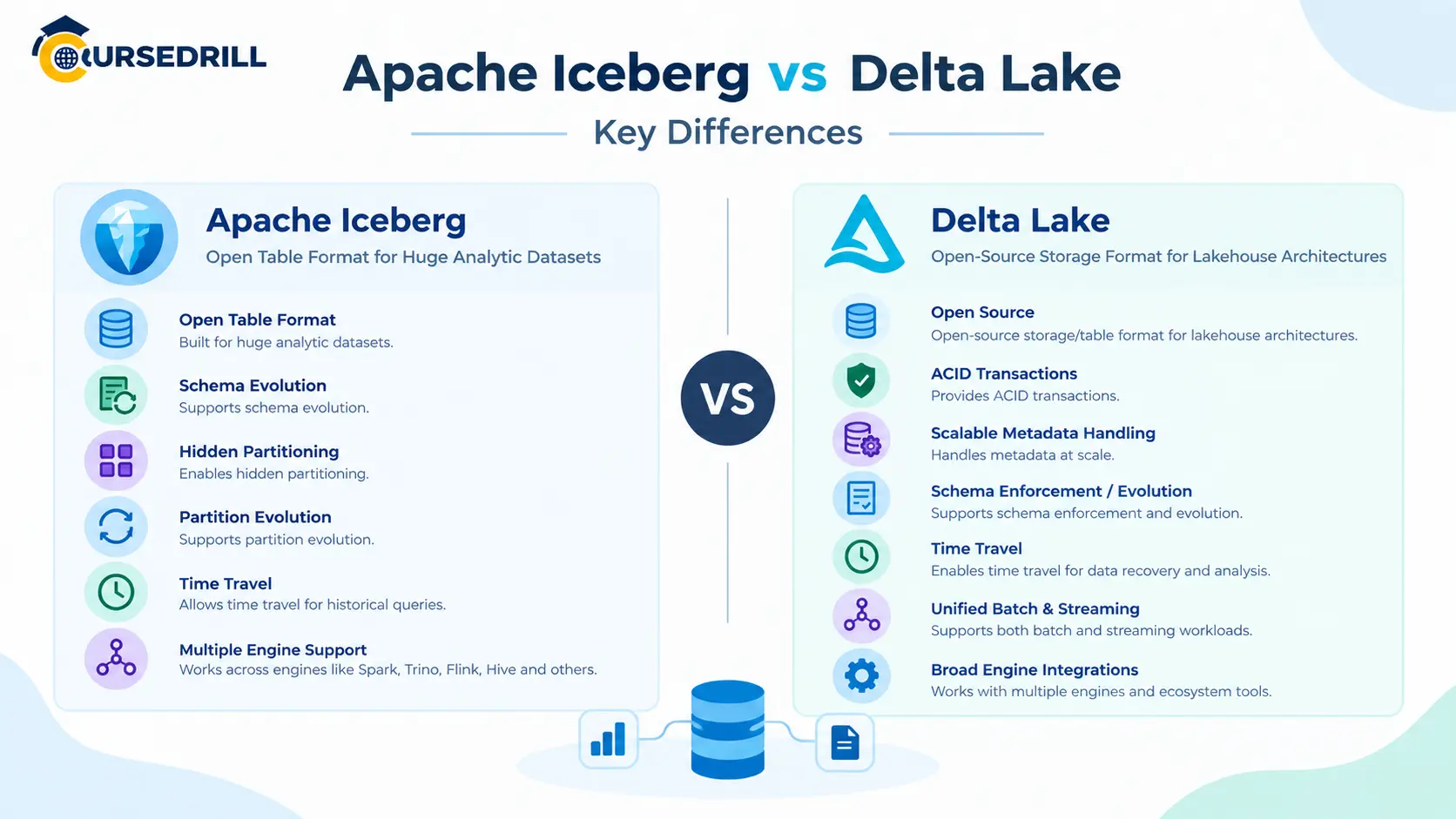
Apache Iceberg vs Delta Lake
Both formats set out to solve the same problem: a folder of Parquet files in object storage isn’t a table, it has no atomic writes, no consistent view during concurrent access, and no schema guarantees. Apache Iceberg and Delta Lake both fix that by adding a metadata layer on top. Where they differ is in exactly how that layer is structured, who governs the project, and which ecosystem each one was originally built to serve, and those differences shape real decisions about engine support and long-term flexibility even as the feature gap between them keeps narrowing.
If you’re new to Iceberg specifically, our beginner’s tutorial and architecture deep dive cover its metadata tree, snapshots, and delete-file mechanics in detail. This piece puts that architecture side by side with Delta Lake’s, and covers where the two have converged, where they still genuinely differ, and which one makes more sense depending on your stack.
Iceberg vs Delta Lake at a Glance
| Apache Iceberg | Delta Lake | |
|---|---|---|
| Created by | (cite index=”31-1″>Netflix, later donated to the Apache Software Foundation | (cite index=”30-1″>Databricks in 2019, later contributed to the Linux Foundation |
| Metadata structure | (cite index=”35-1″>Hierarchical tree: metadata JSON → manifest list → manifest files → data files | (cite index=”35-1″>Flat transaction log: sequential JSON commit files plus periodic Parquet checkpoints |
| Requires an external catalog to read | Yes, by design | (cite index=”36-1″>No, self-describing; multi-engine write semantics most fully implemented in Spark/Databricks |
| Multi-engine concurrent writes | (cite index=”36-1″>Native, via catalog-based commits from the start | (cite index=”30-1″>Added with coordinated commits in Delta Lake 4.0 (September 2025) |
| Partition evolution | (cite index=”30-1″>Native hidden partitioning, changeable without rewriting data | Historically required explicit partition columns; increasingly superseded by liquid clustering |
| Deletion vectors | (cite index=”18-1″>Introduced in format v3 | (cite index=”38-1″>Available since Databricks Runtime 12.1 |
| Change Data Feed | Row lineage in v3; less turnkey | (cite index=”42-1″>Built-in, enabled via a simple table property |
| Strongest ecosystem fit | (cite index=”36-1″>Snowflake, BigQuery, Trino, Flink, DuckDB, and a broad multi-vendor REST catalog ecosystem | (cite index=”33-1″>Databricks and Apache Spark, described as the tightly integrated default |
| Interoperability bridge | Delta tables can expose Iceberg metadata via UniForm | (cite index=”40-1″>UniForm asynchronously generates Iceberg metadata alongside the Delta log |
Origins and Governance
(cite index=”31-1″>Apache Iceberg was developed by Netflix and later donated to the Apache Software Foundation, following the path described in more detail in our beginner’s guide, born out of the specific limitations of Hive-style tables at Netflix’s scale. Its governance today sits with the ASF, with contributions spread across a genuinely broad set of companies and vendors rather than concentrated in any one commercial entity.
(cite index=”30-1″>Delta Lake was created by Databricks in 2019 and later contributed to the Linux Foundation. It was built with Apache Spark in mind, and its strongest performance and deepest feature integration remain within the Spark and Databricks ecosystem. That Linux Foundation contribution matters for the licensing story, Delta Lake genuinely is open source, but it’s worth being clear-eyed that its feature roadmap has, in practice, tracked Databricks’ own product priorities more closely than Iceberg’s roadmap tracks any single vendor.
Architecture: A Tree vs. a Log
This is the core structural difference, and nearly every other distinction in this comparison traces back to it.
(cite index=”35-1″>Delta Lake stores its transaction log as JSON files in a _delta_log/ directory, sequential commit files like 00000.json and 00001.json, with periodic Parquet checkpoint files rolling up older commits. The transaction log itself is a flat sequence of operations. Apache Iceberg, by contrast, stores metadata as a hierarchy: a metadata JSON file points to a manifest list, which points to manifest files, which point to the actual data files, with each snapshot forming a complete, self-describing tree rather than a position in a linear sequence.
(cite index=”29-1″>Concretely, a Delta table directory looks like a set of Parquet data files sitting alongside a _delta_log/ folder, where each JSON commit records specific actions, add a file, remove a file, change table metadata, or set a protocol version. That flat, append-only log design has a genuine advantage: (cite index=”36-1″>it’s self-describing and doesn’t require an external catalog just to read it, a client can open the _delta_log/ directory directly and reconstruct the current table state from the commit history.
Iceberg trades that self-contained simplicity for a different set of guarantees. (cite index=”28-1″>Both formats support ACID transactions, but Iceberg’s hierarchical metadata scales more predictably with table size, since manifest files partition the metadata itself rather than requiring a client to potentially replay a long, flat sequence of commits.
The dependency on an external catalog, Hive Metastore, AWS Glue, a REST catalog, or others, isn’t a limitation so much as a deliberate design choice: (cite index=”36-1″>multiple engines can commit through the same catalog API with consistent concurrency semantics, since the catalog itself, not any one engine’s internal log format, is the single arbiter of what the table’s current state actually is.
Multi-Engine Writes: Where the Two Started Furthest Apart
This is one of the areas where the two formats’ original design intentions show through most clearly, and where the recent Delta Lake changes are most telling. (cite index=”36-1″>Iceberg’s architecture was built from the outset around multiple engines committing through a shared catalog API, since it needed to serve Netflix’s own genuinely multi-engine environment from day one.
Delta Lake’s original design leaned more heavily on the assumption that Spark (and specifically Databricks-managed Spark) was doing the writing. (cite index=”30-1″>Delta Lake 4.0, released in September 2025, specifically added coordinated commits for multi-engine writes, a feature that closes a real gap but also underscores how much of Delta’s early architecture assumed a Spark-centric write path that Iceberg’s catalog-first model didn’t need to retrofit years later.
Feature Comparison: Where the Gap Has Genuinely Narrowed
For a long stretch, feature comparisons between these two formats were a meaningful part of the decision. That’s changed substantially. (cite index=”30-1″>The feature gap between Iceberg and Delta Lake has narrowed considerably since 2023, so the real decision now comes down to ecosystem fit, engine diversity, and how much vendor coupling you can tolerate rather than which format can technically do more.
Deletion vectors, the compact bitmap-based approach to marking rows deleted without rewriting entire files, exist on both sides now. (cite index=”38-1″>Delta Lake has supported deletion vectors since Databricks Runtime 12.1, letting it mark deleted rows without rewriting the whole Parquet file, which used to be Delta’s answer to the same operational pain Iceberg’s merge-on-read deletes address.
Iceberg reached functional parity here with (cite index=”18-1″>format v3’s own deletion vectors, compact Roaring-bitmap structures stored in Puffin files, covered in detail in our Iceberg architecture guide.
Liquid clustering, Databricks’ newer replacement for manual partitioning and Z-ordering, is a genuine Delta Lake advantage, at least for now. (cite index=”39-1″>Liquid clustering is a data layout optimization technique that replaces table partitioning and ZORDER, letting you redefine clustering keys without rewriting existing data as analytic needs evolve. Interestingly,
(cite index=”39-1″>Databricks has extended liquid clustering into public preview for managed Apache Iceberg tables too, with Iceberg v3 tables supporting deletion vectors, row tracking, row-level concurrency, and automatic liquid clustering, blurring what used to be a clean Delta-only feature line, though this Iceberg-side support currently exists specifically within Databricks’ own managed Iceberg tables rather than as a universal cross-engine capability.
Change Data Feed remains one of Delta’s more turnkey advantages for CDC-style pipelines. (cite index=”42-1″>Enabling it is as simple as setting enableChangeDataFeed to true on a table, giving downstream consumers a straightforward, row-level change stream without extra tooling. Iceberg’s v3 row lineage tracking, covered in our architecture piece, addresses a related need, but it’s a newer capability with less turnkey, engine-agnostic tooling built around it so far.
Hidden partitioning and partition evolution remain a clearer Iceberg advantage. (cite index=”30-1″>Iceberg’s native hidden partitioning lets partitioning strategy evolve without requiring a rewrite of historical data, a capability baked into the format’s core design from the start, whereas Delta’s traditional partitioning model required more manual planning up front, before liquid clustering began closing that specific gap from the Delta side.
Ecosystem and Engine Support
This is where the practical difference remains most pronounced, even as raw feature parity converges. (cite index=”36-1″>Iceberg’s REST catalog specification has become the standard that a broad swath of the ecosystem is implementing, with Snowflake, BigQuery, Trino, Flink, and DuckDB all treating it as a native, first-class format. (cite index=”30-1″>On the catalog side specifically, AWS Glue alone accounts for roughly 39.3 percent adoption in the 2025 Iceberg ecosystem survey, with Nessie, Lakekeeper, Unity Catalog, and the traditional Hive Metastore rounding out the rest, illustrating just how many distinct catalog implementations the Iceberg ecosystem now supports.
Delta Lake’s strongest integration remains squarely within its home ecosystem. (cite index=”33-1″>Databricks currently uses Delta Lake as its default table format, describing it as tightly integrated with Apache Spark and Structured Streaming, and organizations already standardized on Databricks or Spark get a noticeably smoother, more deeply optimized experience than they would bolting Iceberg onto the same stack. (cite index=”32-1″>Some platforms, Microsoft Fabric among them, have specifically chosen Delta Lake as their standard, which matters directly if your organization is already committed to that platform.
The Convergence: UniForm and Databricks’ Acquisition of Tabular
No comparison of these two formats in 2026 is complete without covering the event that reshaped the entire conversation. (cite index=”40-1″>Databricks introduced UniForm in 2023 and acquired Tabular, the company founded by Iceberg’s original creators, in 2024. UniForm enables interoperability between open data formats, Delta, Iceberg, and Hudi, allowing practitioners to access table data in cloud object storage regardless of which platform they choose, governed centrally through Unity Catalog.
The mechanism itself is fairly elegant. (cite index=”36-1″>Delta UniForm, formally called “Iceberg reads on Delta Lake” in Databricks’ own documentation, lets Delta Lake tables in Unity Catalog be read by external Iceberg clients without rewriting or copying the underlying Parquet data. When enabled, Databricks asynchronously generates Iceberg metadata alongside the existing Delta transaction log. In effect, you write Delta and get an Iceberg-readable table for free, at least for read access from Iceberg-native engines.
That’s changed the actual shape of the decision more than the format war narrative usually admits. (cite index=”36-1″>The practical implication is that the Iceberg vs Delta choice is becoming a catalog and governance choice rather than a raw feature-capability choice. If you’re on Databricks, you write Delta and expose it as Iceberg, effectively getting both. If you’re on Snowflake, BigQuery, or building around a REST catalog, you write Iceberg directly, and it’s queryable by Delta-aware engines too.
Worth flagging as a real, current limitation rather than glossing over it: (cite index=”40-1″>Delta tables exposed via UniForm’s Iceberg reads do not currently support Delta’s own deletion vectors in that exposed Iceberg view, a gap expected to close as Iceberg v3 adoption matures across the ecosystem. Interoperability here is real and useful, but it isn’t yet perfectly lossless in every direction.
Community and Adoption Signals
Beyond the architectural and ecosystem points above, it’s worth looking at where each project’s community energy is actually concentrated, since that shapes how quickly gaps get closed and how much third-party tooling exists for troubleshooting either format in production.
Iceberg’s community reflects its multi-vendor governance model directly. Contributions come from engineers at Netflix, Apple, Snowflake, AWS, Tabular (now part of Databricks), and a long tail of other companies with a direct stake in a format that isn’t tied to any single platform. That structure has produced the broad catalog ecosystem covered above, Hive Metastore, Glue, REST, Nessie, JDBC, and Lakekeeper all coexisting as legitimate options rather than one implementation dominating by default.
Delta Lake’s community, while genuinely active and open, remains more centered around Databricks itself as the primary corporate steward, which has advantages and tradeoffs of its own. The advantage is coherence, features like liquid clustering and Change Data Feed tend to ship polished and well-documented because one company is driving the roadmap end to end.
The tradeoff is that the pace and direction of that roadmap answers more directly to Databricks’ own commercial priorities than a purely community-driven project’s would, a dynamic worth weighing the same way you would when evaluating any vendor-led open-source project versus a foundation-governed one.
Neither structure is inherently wrong, they simply optimize for different things. A foundation-governed, multi-vendor project like Iceberg tends to produce broader, slower-to-fragment ecosystem support. A vendor-led project like Delta Lake tends to produce faster, more tightly integrated feature delivery within its home platform, at the cost of that platform mattering more to how well the format performs elsewhere.
Performance Considerations
Raw performance differences between the two formats have narrowed alongside their feature sets, and most current benchmarks show workload-dependent results rather than a consistent winner either way. Where real differences do show up, they tend to trace back to the same architectural distinction covered earlier: Iceberg’s manifest-based statistics enable aggressive file pruning during query planning without needing to touch a linear commit history, which tends to help most on tables with a very large number of historical commits, where Delta’s checkpoint mechanism exists specifically to keep replaying that flat log from becoming a bottleneck.
Delta Lake’s liquid clustering, in turn, has shown strong, well-documented performance gains specifically on Databricks-managed compute, since it was designed and tuned against that exact runtime. In practice, benchmarking your own workload on your own engine remains far more informative than any generic cross-format number, since both formats’ actual performance depends heavily on catalog choice, compaction discipline, and which engine is doing the reading.
When to Choose Apache Iceberg
Iceberg tends to be the stronger choice when:
- You need genuine multi-engine flexibility, querying and writing the same tables from Snowflake, BigQuery, Trino, Flink, and Spark without being tied to one vendor’s runtime.
- Partition evolution is a real, anticipated need, letting your physical data layout change as query patterns evolve without a disruptive historical rewrite.
- You’re building a new, greenfield lakehouse in 2026 specifically and want to align with what independent comparisons currently describe as the broader ecosystem standard, particularly via the REST catalog specification.
- You want format governance that isn’t concentrated in a single commercial vendor’s product roadmap, even accounting for Databricks’ acquisition of Tabular.
- You’re already invested in Trino, where Iceberg is the natively favored table format, as covered throughout our Trino architecture content.
When to Choose Delta Lake
Delta Lake tends to be the stronger choice when:
- Your organization is already standardized on Databricks or Apache Spark, where Delta’s tooling, performance optimizations, and support are most deeply integrated.
- You want Change Data Feed’s turnkey, built-in CDC capability without assembling equivalent tooling around Iceberg’s newer row lineage tracking.
- Liquid clustering’s automatic, maintenance-free data layout optimization is a priority, and you’re comfortable with it currently being most mature on native Delta tables.
- You’re on a platform like Microsoft Fabric that has already chosen Delta Lake as its standard table format.
- You want UniForm’s interoperability path, writing Delta while still exposing your tables to the broader Iceberg-reading ecosystem, without a full migration.
Frequently Asked Questions
Is Apache Iceberg or Delta Lake more open source? Both are genuinely open source, Iceberg governed by the Apache Software Foundation and Delta Lake contributed to the Linux Foundation. The more meaningful distinction in practice is influence rather than licensing: Delta Lake’s roadmap has historically tracked Databricks’ own product priorities more closely, while Iceberg’s contributor base is spread across a broader set of vendors and organizations.
Do I need a separate catalog to use Iceberg, but not Delta Lake? Effectively, yes. Delta Lake’s transaction log is self-describing and can be read directly from its _delta_log/ directory without an external catalog. Iceberg is built around a catalog, Hive Metastore, AWS Glue, a REST catalog, or others, that holds the single, authoritative pointer to a table’s current metadata, which is also what enables its native multi-engine, multi-writer concurrency model.
Do both formats support deletion vectors now? Yes. Delta Lake has supported deletion vectors since Databricks Runtime 12.1, and Apache Iceberg added its own version with format v3, covered in detail in our Iceberg architecture guide.
What is UniForm and does it mean I don’t have to choose between the two? UniForm is a Databricks feature that asynchronously generates Iceberg-compatible metadata alongside a table’s native Delta transaction log, letting Iceberg-native engines read Delta tables without a separate copy or rewrite. It significantly reduces lock-in risk if you’re on Databricks, but it isn’t yet perfectly lossless in every direction, some Delta-specific features like deletion vectors aren’t currently visible through the exposed Iceberg view.
Which format has broader support across cloud data platforms? As of 2026, Apache Iceberg has the broader native footprint, with Snowflake, BigQuery, Trino, Flink, and DuckDB all treating it as a first-class format, alongside a wide range of catalog implementations. Delta Lake’s deepest integration remains within Databricks and the Apache Spark ecosystem specifically, along with platforms like Microsoft Fabric that have adopted it as their standard.
Is liquid clustering exclusive to Delta Lake? It originated as a Delta Lake feature, but Databricks has extended a public-preview version of liquid clustering to managed Apache Iceberg v3 tables as well, within Databricks’ own runtime. It isn’t yet a universal, cross-engine Iceberg capability the way hidden partitioning is.
Should I pick a format based on features alone in 2026? Probably not as the primary factor anymore. Independent comparisons increasingly frame this as a catalog, governance, and ecosystem decision rather than a feature checklist, since core capabilities like ACID transactions, schema evolution, time travel, and now deletion vectors exist on both sides. Which engines you need to support and how much vendor coupling you’re comfortable with matter more than any single remaining feature gap.
Final Verdict
The feature war between these two formats is largely over, both handle ACID transactions, schema evolution, time travel, and now deletion vectors competently. What’s left is a genuine architectural difference, Iceberg’s catalog-anchored metadata tree versus Delta’s self-describing linear log, and a genuine ecosystem question: how much of your stack sits inside Databricks and Spark versus spread across Snowflake, BigQuery, Trino, and other engines that increasingly treat Iceberg as the default.
If you’re building fresh in 2026 without an existing Databricks commitment, the broader ecosystem consensus favors starting with Iceberg. If you’re already deep in Databricks or Spark, Delta Lake remains excellent in that context, and UniForm means the choice is less permanent than it used to be. For the deeper technical grounding on Iceberg’s side of this comparison, our architecture explained guide covers the manifest tree, sequence numbers, and format versions referenced throughout this piece, and Delta Lake’s official documentation is the best place to go deeper on the transaction log and Delta Kernel internals from the other side.
For more breakdowns of open-source data infrastructure and DevOps tooling like this one, keep exploring the guides on CourseDrill.
Popular Courses