- Posted on
- admin
- No Comments
What Is Infisical? Complete Guide
Most engineering teams don’t set out to build a secrets management strategy. It happens by accident, one .env file at a time, until someone pastes a production database password into Slack to unblock a teammate, and everyone in the channel quietly realizes that’s now a security incident waiting to be discovered. Infisical was built directly out of that exact frustration, by two engineers who’d lived it firsthand.
It’s grown since then into a full secrets management platform: open source, end-to-end encrypted, and pitched explicitly as the tool for teams who want something more secure than scattered .env files without taking on the operational weight of running HashiCorp Vault. This guide covers what Infisical actually is, how its encryption architecture works, what it can do beyond basic secret storage, what it costs, and where it fits against the alternatives.
Where Infisical Came From
(cite index=”34-1″>Infisical was founded in 2022 by Maidul Islam and Tony Dang, both former engineers who experienced firsthand the pain of secrets management in fast-moving engineering teams. The company went through Y Combinator’s Winter 2023 batch and has raised funding to accelerate platform development. That origin story shows up directly in the product’s design priorities: Infisical reads less like infrastructure software built for a platform team and more like a tool built by developers who were personally tired of the problem it solves.
(cite index=”34-1″>In just a few years, it’s gone from a basic open-source .env replacement to a comprehensive secrets platform with dynamic secrets, PKI, SSH certificates, and Kubernetes-native integration, and the community response has been loud about it. (cite index=”31-1″>User testimonials collected on Infisical’s own site describe deleting every .env file from disk after adopting it, and one specifically mentions moving credentials over after “the Vercel incident,” a nod to how seriously credential leaks get taken once a team has actually been burned by one.
What Is Infisical?
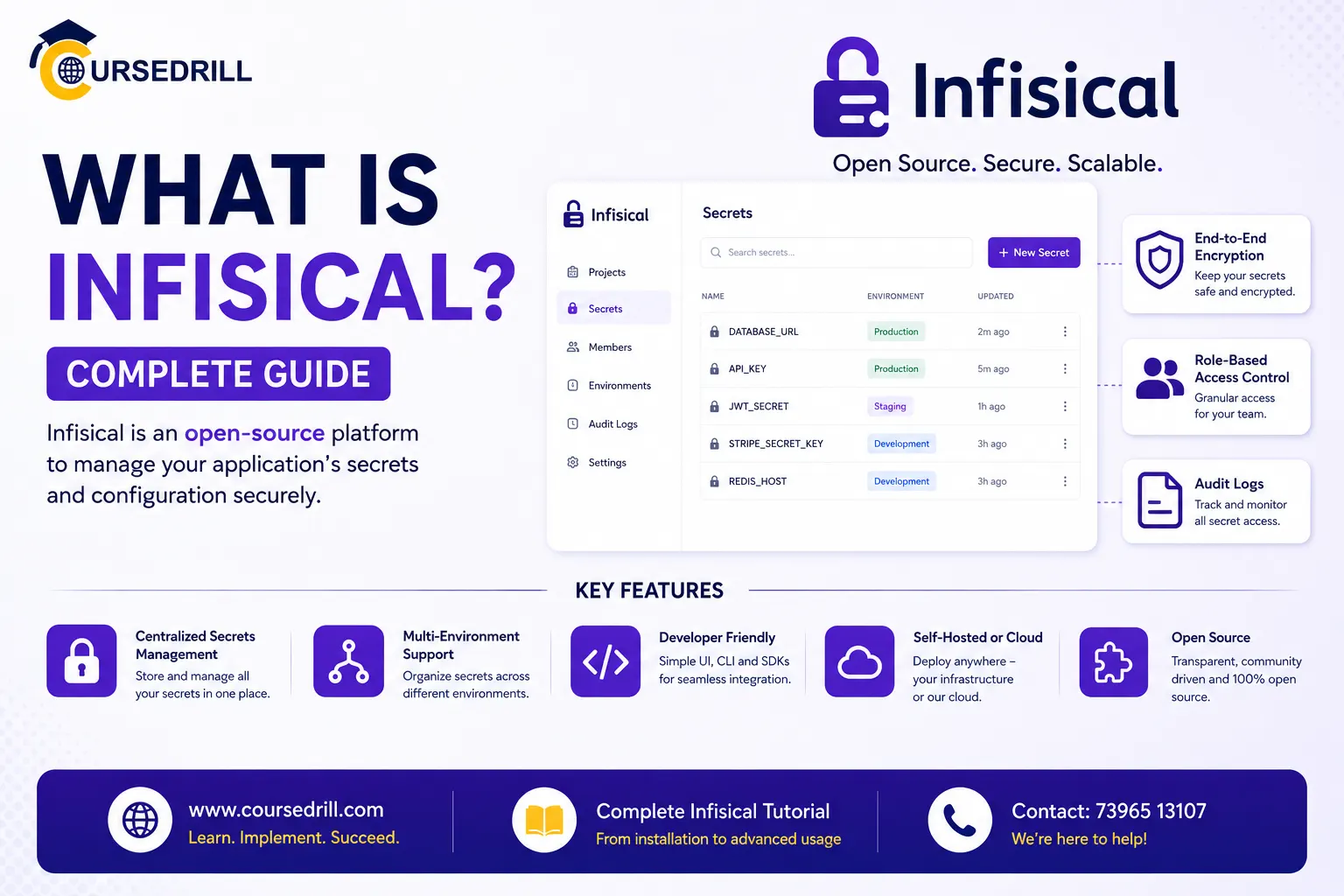
(cite index=”25-1″>Infisical is the open source secret management platform that teams use to centralize their application configuration and secrets, like API keys and database credentials, as well as manage their internal PKI. (cite index=”33-1″>It provides a centralized, audited, and encrypted store for API keys, database credentials, and environment variables, positioning itself as a self-hosted alternative to Vault with end-to-end encryption, a CLI, SDKs, a Kubernetes Operator, and secret rotation built in.
The framing Infisical uses for itself is worth repeating directly, because it captures the gap the product is aimed at: (cite index=”27-1″>tools like HashiCorp Vault are powerful but operationally complex, and AWS Secrets Manager exists only in the cloud, while Infisical bridges the gap to the developer, an end-to-end encrypted platform that securely manages secrets not only in the cluster but also on a developer’s own laptop.
Whether or not you buy the framing entirely, it’s an accurate description of where the product sits: closer to Vault in capability than a simple .env sync tool, but built with a level of developer ergonomics that Vault, by most accounts, has never prioritized.
How Infisical’s Architecture Works
The single most distinctive thing about Infisical, architecturally, is how seriously it takes end-to-end encryption, and what that actually means in practice rather than as a marketing line.
Client-Side Encryption and the “Blind Backend”
(cite index=”27-1″>Infisical uses a client-side encryption architecture sometimes described as a “blind backend.” Secrets are encrypted on the user’s client, whether that’s a browser or the CLI, before being sent to the server. Even if the server were compromised, an attacker would only see encrypted, useless data.
That’s a meaningfully different security model than what most secrets managers, including cloud-native options, actually implement. (cite index=”27-1″>Most secret managers, AWS Secrets Manager included, encrypt data “at rest,” which means the provider holds the key and could theoretically read the data.
Infisical’s client-side model means secrets are encrypted before they ever leave the user’s device. (cite index=”33-1″>Concretely, secrets are encrypted client-side using AES-256-GCM, and the server stores only ciphertext, unable to read plaintext secrets without the workspace key derived from user credentials.
(cite index=”27-1″>In practice, since Infisical stores only encrypted blobs in its underlying PostgreSQL database, even an attacker who stole the entire database couldn’t do anything with it without the client-side keys. It’s a stronger guarantee than “we encrypt your data,” it’s closer to “we structurally cannot read your data even if we wanted to.”
Server Components
Under the hood, (cite index=”33-1″>Infisical’s server is composed of three main components: an API server, a Node.js backend that handles all secrets operations, alongside supporting services for the web dashboard and background processing. The stack itself is (cite index=”28-1″>primarily TypeScript with a Go component, backed by PostgreSQL for storage, which is a fairly conventional, well-understood technology choice for a team prioritizing developer familiarity over novel infrastructure.
How Secrets Are Organized
(cite index=”30-1″>Infisical structures secrets in a hierarchy of building blocks: a Project sits at the top, for example an “orders-service” project, containing environments like development, staging, and production, which in turn can contain folders for further organization.
That hierarchy maps naturally onto how most engineering teams already think about their systems, one project per service or repo, environments matching deployment stages, which is part of why the learning curve tends to be shorter than platforms built around more abstract concepts like Vault’s realms or mount paths.
Core Features
Secrets dashboard. (cite index=”25-1″>A user-friendly interface lets teams manage secrets across projects and environments, development, production, and anything in between, without needing to memorize CLI syntax for routine changes.
Secret versioning and point-in-time recovery. (cite index=”25-1″>Every secret and project state gets tracked, with the ability to roll back when needed. (cite index=”27-1″>If someone accidentally overwrites a production API key, you can roll back to the exact version from a specific point in time with one click, a capability the article’s author notes AWS Secrets Manager only offers in a more rudimentary form.
Secret rotation. (cite index=”25-1″>Secrets can be rotated at regular intervals for services like PostgreSQL, MySQL, and AWS IAM, among others, reducing how long any single credential stays valid even under normal, non-incident conditions.
Dynamic secrets. (cite index=”34-1″>Infisical supports dynamic secrets, generating short-lived credentials on demand rather than relying purely on static, long-lived values, the same underlying idea Vault popularized: a credential that gets created fresh for a specific need and expires automatically rather than sitting around indefinitely.
Native integrations and syncing. (cite index=”25-1″>Secrets can sync to platforms like GitHub, Vercel, and AWS, and integrate with infrastructure tools like Terraform and Ansible. (cite index=”42-1″>The published integration list includes GitHub Actions, GitLab CI/CD, a Kubernetes Operator and CSI Driver, AWS Secrets Manager, GCP Secret Manager, Azure Key Vault, Vercel, and Ansible, covering most of the places a modern engineering team’s secrets actually need to end up.
PKI and SSH certificate management. (cite index=”42-1″>Beyond secrets storage, Infisical positions itself as a unified platform covering secrets, PKI certificates, and SSH access management under one roof, rather than requiring a separate tool for certificate issuance.
Secret scanning. (cite index=”42-1″>Secret scanning and leak prevention is built into the free tier, catching credentials that accidentally make their way into a git commit before they ship, which is precisely the kind of accident that tends to precede the Slack-password-paste story teams tell after the fact.
Machine identities. (cite index=”33-1″>A Machine Identity is a non-human principal, letting service accounts, CI/CD pipelines, and automated workloads authenticate to Infisical the same way a human user would, with the same scoped permissions model.
Licensing: Open Core, Not Fully Open Source
This is worth being precise about, because “open source” gets used loosely in this category and Infisical’s actual structure is a specific, well-defined open-core model.
(cite index=”37-1″>Infisical uses MIT for the core codebase, a genuinely permissive open-source license, no asterisks, more generous than AGPL and other “sustainable use” licenses common in this space. But that’s not the whole codebase. (cite index=”37-1″>Everything inside the backend’s ee/ directory, over 800 files, is covered by the Infisical Enterprise License instead. You can read that code on GitHub, but you can’t run it in production without purchasing a license key.
The enterprise license permits modifying the code and publishing patches, but Infisical retains rights over those modifications, and use requires a valid subscription for the correct number of seats. (cite index=”37-1″>Copying and modifying that code for development and testing purposes doesn’t require a subscription, only running it in production does.
(cite index=”35-1″>In practice, this splits cleanly: the Infisical core is MIT-licensed, while enterprise features like SSO, advanced audit logs, and dynamic secrets connectors at scale are commercial, a model similar in spirit to HashiCorp Vault’s open-source-plus-Enterprise structure, just with a more permissive base license than Vault’s current BSL.
If you’re specifically choosing Infisical over Vault because of licensing purity, it’s worth understanding that Infisical isn’t fully open source either, it’s open core, with a meaningful and growing slice of functionality gated behind a commercial license.
One detail worth flagging precisely because it’s easy to miss: (cite index=”37-1″>SAML SSO and RBAC are gated at the Pro tier, not held back for Enterprise the way you might expect, which changes the calculus for smaller teams that assumed SSO would only matter once they were large enough to need Enterprise anyway.
Pricing
Infisical’s pricing model has a specific quirk worth understanding before you estimate costs for your team.
(cite index=”38-1″>Infisical Cloud is free for up to 5 identities, 3 projects, and 3 environments. (cite index=”42-1″>The free tier also includes secret scanning and leak prevention, and 10 integrations, making it genuinely usable for a solo developer or a very small team, not just a crippled trial.
(cite index=”38-1″>Beyond the free tier, the Pro plan costs $18 per identity per month, and critically, an “identity” is any human or machine that authenticates to Infisical, so CI pipelines, service accounts, and Kubernetes workloads each add to the bill the same way an additional human seat would. (cite index=”37-1″>Pro unlocks SAML SSO, RBAC, secret versioning, IP allowlisting, and 90-day audit log retention.
(cite index=”38-1″>To put that identity-based math in concrete terms, a team of 10 developers running 20 machine identities, service accounts and CI pipelines, would be billed for 30 identities total, working out to $540 a month on the Pro plan. That’s a materially different cost curve than flat per-seat pricing, since it scales with automation as much as headcount, and teams leaning heavily on CI/CD and service-to-service authentication should model this carefully before assuming Infisical’s pricing will stay cheap as they grow.
(cite index=”37-1″>Enterprise, custom-quoted, gates dynamic secrets, SCIM, LDAP, approval workflows, KMIP, and HSM support. Notably, dynamic secrets sit behind the Enterprise paywall on Infisical Cloud specifically, worth knowing if that capability is a core requirement for your evaluation rather than a nice-to-have.
Self-hosting sidesteps the identity-based billing model entirely for the MIT-licensed core. (cite index=”34-1″>The open-source core is free and self-hostable via Docker Compose or Kubernetes with Helm, though the Enterprise-licensed features inside the ee/ directory still require a commercial license to actually run, even on infrastructure you own and operate yourself.
Deployment Options
(cite index=”34-1″>Infisical Community Edition is free and self-hostable via Docker Compose or Helm 3 on a Kubernetes cluster. For teams that don’t want to run infrastructure at all, Infisical Cloud offers the managed SaaS path, with the free tier described above as a genuinely workable starting point rather than a time-boxed trial.
For Kubernetes-native teams specifically, (cite index=”42-1″>a dedicated Kubernetes Operator and CSI Driver let secrets flow directly into pods without an application needing to call Infisical’s API itself, which tends to be the smoothest integration path for teams already running most of their infrastructure on Kubernetes.
Infisical vs. HashiCorp Vault
The comparison to Vault comes up constantly in Infisical’s own positioning, and it’s worth addressing directly rather than dancing around it. (cite index=”33-1″>Vault is more flexible but requires significant operational expertise, while Infisical is easier to self-host and ships with a developer-friendly dashboard. (cite index=”39-1″>HashiCorp Vault remains the reference platform for advanced secrets management, dynamic database credentials, encryption-as-a-service, PKI at scale, and an auth method for nearly everything, and if Infisical’s Enterprise tier is gating the dynamic-secrets features you specifically need, Vault is the deepest implementation of those ideas available.
(cite index=”41-1″>The honest verdict most independent reviewers land on: choose Infisical over Vault when you want simpler ergonomics and self-hosting without Vault’s operational weight, and pick Vault if you need its breadth and long track record at scale. (cite index=”40-1″>Infisical is younger than Vault, so the hardest enterprise edge cases are less proven, a fair caveat for any team doing a serious risk evaluation rather than just picking the more pleasant tool to use day to day.
If pure open-source licensing, rather than developer experience, is what’s driving your evaluation away from Vault specifically, it’s worth knowing that OpenBao, not Infisical, is the closer match. Our OpenBao vs HashiCorp Vault comparison covers that specific angle in depth, since OpenBao is a direct, fully open-source fork of Vault itself, whereas Infisical is a different product built from scratch with a different architecture and an open-core licensing model of its own.
Infisical vs. Doppler
The other comparison that comes up constantly is Doppler, the closest fully-managed SaaS competitor. (cite index=”34-1″>Infisical is open-source and self-hostable, while Doppler is SaaS-only. Infisical supports dynamic secrets, which Doppler does not, though Doppler has more secret sync integrations and a slightly more polished user experience, a gap independent reviewers describe Infisical as closing rapidly.
The practical decision point: if self-hosting matters to you at all, whether for compliance, cost control at scale, or just not wanting your secrets living exclusively on someone else’s infrastructure, Infisical is in a different category than Doppler entirely, since Doppler doesn’t offer a self-hosted option at any price.
Who Should Use Infisical?
Infisical tends to be the right fit for teams that:
- Want a modern, developer-friendly interface for secrets management without Vault’s steeper operational learning curve.
- Value end-to-end, client-side encryption specifically, rather than the more common at-rest encryption model where the provider technically holds the keys.
- Need both a managed SaaS option and a genuine self-hosted path, without being locked into one or the other.
- Are comfortable with an open-core model, MIT for the base product, commercial licensing for advanced features, rather than requiring a fully open-source stack top to bottom.
- Run a meaningful number of machine identities and want to budget carefully around identity-based pricing before scaling automation heavily on the Cloud Pro tier.
It’s a weaker fit if dynamic secrets are a hard requirement on Infisical Cloud specifically without an Enterprise contract, or if your organization needs the deepest possible feature set and decade-plus production track record that Vault still offers at the high end of enterprise secrets management.
Frequently Asked Questions
Is Infisical fully open source? Not entirely. The core codebase is MIT-licensed and genuinely open source, but enterprise features like SSO, SCIM, LDAP, approval workflows, and dynamic secrets at scale live under a separate proprietary Infisical Enterprise License, viewable on GitHub but requiring a paid subscription to run in production.
How does Infisical’s encryption differ from most secrets managers? Most secrets managers, including major cloud providers, encrypt data at rest, meaning the provider holds the decryption key and could theoretically access your data. Infisical encrypts secrets client-side before they ever reach its servers, so the backend only ever stores ciphertext and cannot read plaintext secrets without keys derived from the user’s own credentials.
How much does Infisical cost? Infisical Cloud is free for up to 5 identities, 3 projects, and 3 environments. Beyond that, the Pro plan costs $18 per identity per month, counting both human users and machine identities like CI pipelines and service accounts. Enterprise is custom-quoted and gates dynamic secrets, SCIM, and approval workflows. The open-source core remains free to self-host at any scale.
What counts as an “identity” in Infisical’s pricing? Any principal that authenticates to Infisical, human or machine. A developer logging in counts as one identity, and so does each CI/CD pipeline, service account, or automated workload connecting to retrieve secrets, which can make costs scale faster than simple per-seat pricing for automation-heavy teams.
Can I self-host Infisical for free? Yes, the MIT-licensed core is free to self-host via Docker Compose or Kubernetes with Helm. Enterprise-licensed features still require a paid subscription to run in production, even on self-hosted infrastructure.
Does Infisical support dynamic secrets like Vault? Yes, though on Infisical Cloud specifically, dynamic secrets sit behind the custom-quoted Enterprise tier rather than being available on the free or Pro plans, worth confirming directly if it’s a hard requirement for your evaluation.
Is Infisical a good replacement for HashiCorp Vault? For teams that find Vault’s operational complexity a genuine burden and want a more developer-friendly self-hosted or SaaS option, yes, many teams describe it that way. For organizations that need Vault’s full breadth of enterprise features, replication, HSM integration, or the deepest possible auth method coverage, Vault still leads, and Infisical is a younger project with a shorter production track record at the highest end of scale.
How is Infisical different from OpenBao? They solve similar problems but come from different starting points. OpenBao is a fully open-source (MPL 2.0) fork of HashiCorp Vault’s own codebase, built to preserve Vault’s exact operational model under open governance. Infisical is a separate product built from scratch with its own architecture, end-to-end client-side encryption and an open-core licensing model, rather than being a Vault fork at all.
Final Thoughts
Infisical’s pitch is straightforward and, based on how quickly its GitHub community has grown, clearly resonant: secrets management shouldn’t require the operational overhead of running Vault, and it shouldn’t mean trusting a provider to hold your encryption keys either. Client-side, end-to-end encryption combined with a genuinely pleasant developer experience is a real differentiator, not just marketing language, and the open-core model gives teams a legitimate free self-hosted path rather than a crippled trial dressed up as open source.
Whether it’s the right choice over Vault or OpenBao depends mostly on what you’re optimizing for. If developer experience and a faster path to a working setup matter more than a decade of enterprise-scale battle-testing, Infisical is a strong, increasingly mature option. If your organization needs the deepest possible feature set or a fully open-source stack with no commercial gating anywhere in the codebase, it’s worth weighing Vault and OpenBao alongside it rather than assuming Infisical covers every requirement out of the box.
For the authoritative, current reference on every feature and configuration option covered here, Infisical’s official documentation is the best place to go deeper before committing to a deployment.
For more breakdowns of open-source infrastructure and DevOps security tooling like this one, keep exploring the guides on CourseDrill.
Popular Courses