- Posted on
- admin
- No Comments
What Is MotherDuck and How Does It Work?
Most data warehouses were built on a single assumption: your data is enormous, so your infrastructure needs to be enormous too. Snowflake, BigQuery, and Redshift all trace their design back to a world where “big data” genuinely meant petabytes spread across clusters of machines. MotherDuck was built on the opposite bet, that the overwhelming majority of companies never actually reach that scale, and that forcing them onto distributed, cluster-based infrastructure anyway is expensive overkill for a problem most of them don’t have.
This guide covers what MotherDuck actually is, the small open-source database it’s built on top of, how its hybrid local-and-cloud architecture actually routes a query, what it costs today, and where it fits if you’re evaluating it against a traditional data warehouse.
The Foundation: What Is DuckDB?
MotherDuck doesn’t make sense without understanding DuckDB first, since MotherDuck is, quite literally, DuckDB extended into the cloud. (cite index=”50-1″>DuckDB can be described in either of two ways: an open-source relational database management system that supports SQL, or an in-process SQL OLAP, online analytical processing, database management system.
(cite index=”52-1″>DuckDB began at CWI, the Dutch national research institute for mathematics and computer science, where researchers Hannes Mühleisen and Mark Raasveldt built it as a purpose-built engine for efficient analytical querying, releasing the first open-source version in 2019. In just two years, weekly downloads grew rapidly, and the project was eventually spun off into a separate commercial operation, DuckDB Labs, founded by Mühleisen and Raasveldt themselves.
The “in-process” part of DuckDB’s definition is the detail that matters most for understanding everything MotherDuck does later. Rather than running as a separate server process you connect to over a network, like Postgres or a Snowflake warehouse, DuckDB runs directly inside your own application or script, the same way SQLite does for transactional workloads.
That design is what makes it fast for local analytics with essentially zero setup, and it’s also precisely the thing DuckDB’s own creators had no cloud story for, which is exactly the gap MotherDuck was built to fill.
Where MotherDuck Came From
The founding story here is genuinely unusual for the database industry, two people who’d never met, brought together by a mutual acquaintance, ended up building a company around someone else’s open-source project.
(cite index=”55-1″>Jordan Tigani had spent over a decade building some of the world’s largest data systems, including a stint as a founding engineer on Google’s BigQuery. The systems he’d spent his career building, massively distributed and scaled horizontally across clusters, were overkill for the overwhelming majority of actual workloads he’d seen. When he encountered DuckDB, he immediately recognized what it represented: a database that was shockingly fast for local analytics but had no cloud story of its own.
(cite index=”52-1″>Tigani reached out to Mühleisen at DuckDB Labs, and after gaining Mühleisen’s support, began trying to commercialize the open-source engine. (cite index=”50-1″>Mühleisen and Raasveldt were themselves looking to partner with someone on a commercial cloud offering, and when Tigani connected with them through a mutual friend, Lloyd Tabb, who’s actually responsible for the MotherDuck name itself, they partnered up.
(cite index=”51-1″>By Jordan’s own account, the company first started thinking seriously about the idea in April 2022, and was funded by Madrona, among others, a few months afterward. (cite index=”54-1″>MotherDuck emerged from stealth in November 2022, revealing $47.5 million in combined funding, including a $35 million Series A round led by Andreessen Horowitz following a $12 million seed round led by Redpoint Ventures.
(cite index=”57-1″>The company has since raised further funding, reaching a reported $400 million valuation in a 2023 round, with (cite index=”58-1″>total funding to date of around $100 million across three rounds as a Series B company based in Seattle.
The governance relationship between the two organizations is worth understanding precisely, since it isn’t the typical single-company-owns-everything setup. (cite index=”52-1″>MotherDuck is a member of the DuckDB Foundation, the non-profit organization that owns most of DuckDB’s intellectual property, while DuckDB Labs, DuckDB’s own commercial arm, holds a shareholder stake in MotherDuck itself.
(cite index=”53-1″>DuckDB Labs’ co-founders sit on MotherDuck’s board, and the relationship runs on genuine trust rather than a heavily negotiated contract: DuckDB Labs builds custom engine features specifically for MotherDuck, like write concurrency, while MotherDuck funds ongoing DuckDB development. In short: DuckDB the open-source engine and MotherDuck the commercial cloud product are developed by two legally separate organizations with aligned incentives, not one company wearing two hats.
What Is MotherDuck?
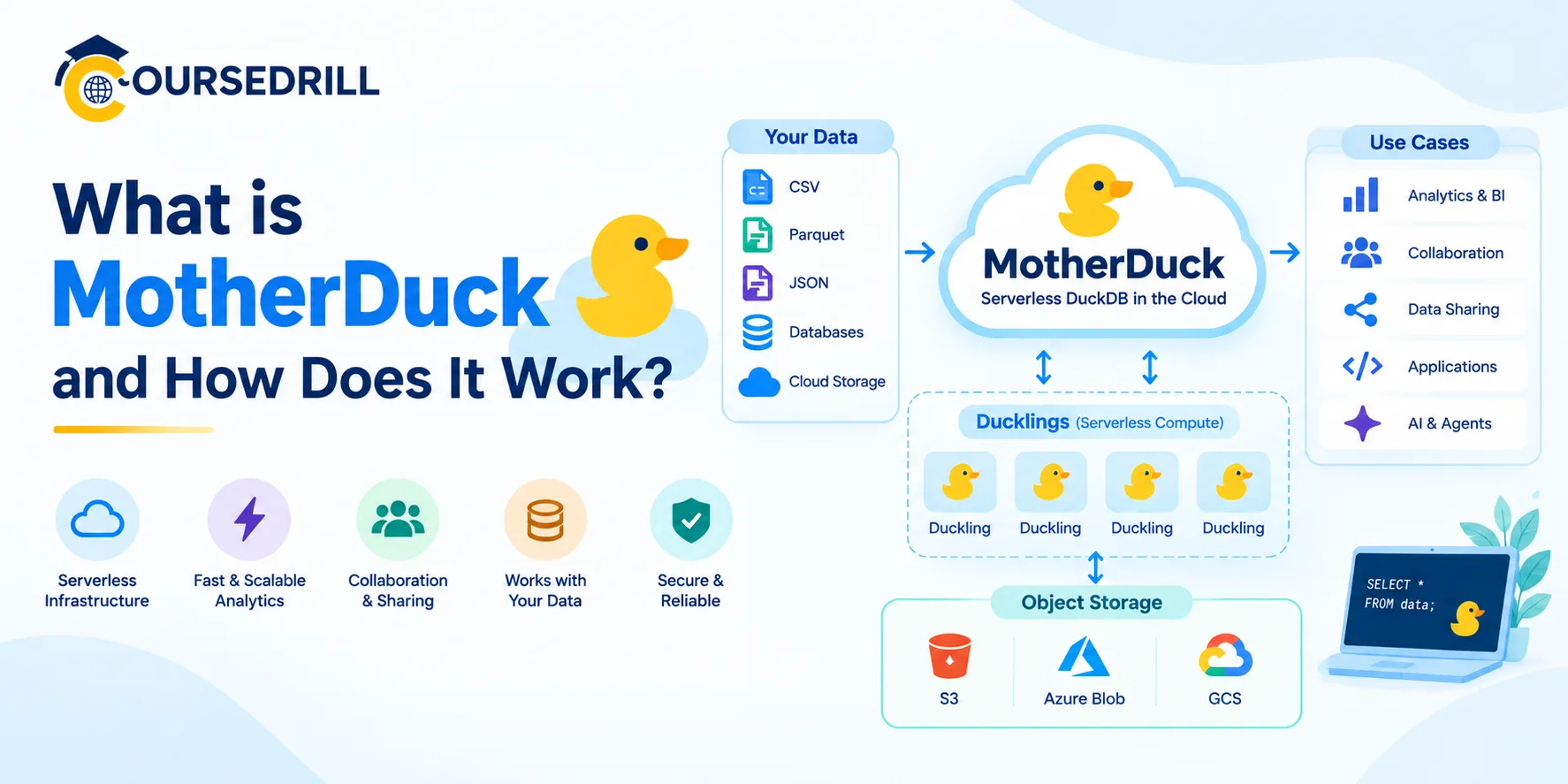
(cite index=”40-1″>MotherDuck is a serverless cloud data warehouse built on DuckDB, with a unique architecture that combines the power and scale of the cloud with the efficiency of DuckDB. (cite index=”42-1″>While DuckDB provides the core analytical engine capabilities, MotherDuck adds cloud storage, sharing, and collaboration features, along with built-in data pipeline and visualization tools on top.
(cite index=”45-1″>Its hypertenancy architecture gives every user or AI agent an isolated compute instance, delivering sub-second analytics with no infrastructure to manage, no resource contention, and lower costs than a traditional warehouse. The pitch, in short: build a modern data warehouse for internal business intelligence, power customer-facing analytics inside your own application, or run AI-agent-driven analytics, developing locally and scaling to the cloud only when you actually need to.
How MotherDuck’s Architecture Works
This is where MotherDuck earns its “unique architecture” description, and it’s worth understanding the mechanics rather than taking the marketing description at face value.
Dual Execution
(cite index=”40-1″>MotherDuck’s Dual Execution model automatically routes a query to whichever location actually holds the data it needs. If a SQL query references data sitting on your own laptop, MotherDuck routes that portion of the query to your local DuckDB instance. If the query references data stored in MotherDuck’s cloud or in cloud object storage, S3, GCS, Azure, or R2, it routes that portion to MotherDuck’s cloud engine instead, which connects to your storage provider directly.
(cite index=”41-1″>MotherDuck determines where each part of a query should run, then routes the execution accordingly, sending heavy processing to the cloud or fetching data to join locally as needed, meaning a single SQL statement can genuinely span data that lives in two completely different places at once, your machine and the cloud, without you writing any special code to make that happen.
That’s a meaningfully different mental model from a traditional warehouse, where all your data has to already be loaded into the warehouse before you can query any of it. With Dual Execution, a quick join between a CSV file still sitting on your laptop and a table already living in MotherDuck’s cloud just works, as a single query.
Hypertenancy and Ducklings
(cite index=”45-1″>MotherDuck’s hypertenancy model gives every user or AI agent an isolated compute instance, and the specific unit of that isolation has its own name. (cite index=”59-1″>A Duckling is MotherDuck’s term for an individual compute instance, and they spin up in roughly 100 milliseconds while keeping tenants fully isolated from each other’s CPU usage.
(cite index=”68-1″>Every Duckling is an isolated bucket of compute, provisioned per organization member (or, increasingly, per AI agent) rather than shared across a whole team the way a traditional warehouse’s compute cluster would be.
That isolation model has a very concrete practical payoff that a case study MotherDuck itself points to makes clear: (cite index=”63-1″>a company called Layers used MotherDuck’s per-tenant hypertenancy architecture to avoid what would otherwise have been a 1000x cost increase running multi-tenant SaaS analytics. Rather than one shared cluster straining under every customer’s queries at once, each tenant effectively gets its own small, isolated, sub-second-billed engine.
Connecting via the DuckDB SDK and md: Protocol
(cite index=”41-1″>DuckDB integrates with MotherDuck using token-based authentication, and because MotherDuck speaks the same DuckDB protocol, virtually any tool with an existing DuckDB driver can connect to MotherDuck simply by changing the connection string, typically to an md: prefix rather than a local file path.
(cite index=”40-1″>Once connected, your regular DuckDB instance gets additional capabilities on top: sharing, secrets storage, better interoperability with S3, and cloud persistence, all layered onto an engine you may already be using locally without realizing it had a cloud counterpart.
The WebAssembly Client
MotherDuck also runs directly inside a web browser. (cite index=”42-1″>The platform’s WASM-powered architecture enables data applications to run the same DuckDB engine that powers the cloud data warehouse directly inside a web browser via WebAssembly.
(cite index=”49-1″>This lets an application offload data processing to a customer’s own machine, providing near-instantaneous data exploration, filtering, and sorting using the exact same SQL engine that powers the cloud service, sometimes described as a “1.5-tier” architecture, since it blurs the usual line between client and server compute entirely.
Core Features
Data sharing. MotherDuck lets you share entire databases with other users or organizations without copying the underlying data, along with zero-copy clones for spinning up a writable copy of a dataset without duplicating storage.
A notebook-style web UI. Alongside the standard DuckDB CLI and Python package, MotherDuck ships its own notebook interface for writing and iterating on SQL directly in the browser, connected to the same cloud engine.
Broad ecosystem integrations. (cite index=”48-1″>MotherDuck integrates with data ingestion tools including Estuary, Fivetran, and Airbyte, transformation tools like dbt and dbt Cloud, visualization tools including Tableau, Power BI, and Looker, and orchestration tools like Airflow and Dagster. (cite index=”43-1″>It also works with Metabase, Superset, Hex, and Omni, or whatever BI tool you already use, generally just faster.
Reading open table formats directly. (cite index=”47-1″>If you already have data in a data lake, stored as Parquet, Delta, Iceberg, or other formats, DuckDB provides abstractions for secrets, object storage, and many file types that let MotherDuck query those tables directly. If you’ve read our Apache Iceberg or Delta Lake guides, this is exactly the kind of engine that can sit on top of either format’s tables without requiring a full migration into a proprietary storage layer first.
pg_duckdb. For teams already running Postgres, an extension lets you run DuckDB’s analytical engine directly within Postgres and connect that same environment to MotherDuck, bridging transactional and analytical workloads without standing up a separate system from scratch.
AI-Native Features
MotherDuck has leaned hard into being a natural backend for AI agents and natural-language analytics, and this is one of the more actively developing parts of the platform.
SQL-native AI functions. (cite index=”64-1″>MotherDuck offers prompt() and embedding() functions directly callable from SQL, letting you invoke an LLM or generate vector embeddings as part of an ordinary query, billed per AI Unit rather than as part of compute or storage charges.
An MCP server for agents. (cite index=”63-1″>MotherDuck’s Model Context Protocol server connects AI agents, Claude, ChatGPT, Cursor, or custom agents, directly to MotherDuck databases, with fuzzy catalog search to help an agent discover the right tables and columns, query guidelines using DuckDB-specific SQL features, and full read and write access so an agent can persist results and build derived datasets.
Cost isolation for agent workloads. (cite index=”63-1″>Because agents are unpredictable and tend to run many queries, often inefficiently, an agent querying a smaller Standard Duckling simply cannot run up costs at a larger Duckling’s price, no matter how many queries it sends, a direct consequence of the hypertenancy model described above.
Dives. (cite index=”63-1″>Dives are interactive, shareable data visualizations that any AI agent can create directly from a query result, without a human needing to manually build a chart.
Pricing
MotherDuck’s pricing structure has changed meaningfully as of early 2026, and it’s worth knowing the current shape rather than an older one still floating around in older reviews. (cite index=”62-1″>MotherDuck currently offers two self-serve plans, Lite and Business.
(cite index=”60-1″>The free Lite tier is capped at 3 internal users, 10 GB of storage, and 10 hours of Pulse compute per month, with community support only. The Business plan costs $250 per month per organization as a platform access fee, plus metered usage on top, a change from an earlier structure that included a $25-per-month Lite tier and a $100-per-month Business plan.
(cite index=”59-1″>Compute is billed per second across five Duckling sizes, Pulse, Standard, Jumbo, Mega, and Giga, ranging from roughly $0.60 to $24.00 per compute-hour depending on size, with storage priced at $0.04 per GB per month. (cite index=”64-1″>AI functions like prompt() and embedding() are billed separately at $1.00 per AI Unit, on top of ordinary compute and storage charges.
Worth knowing if you’re comparing MotherDuck against other engines: (cite index=”59-1″>Ducklings spin up in around 100 milliseconds, and the isolated, per-user hypertenancy model means one heavy user or misbehaving agent can’t degrade performance for anyone else sharing the same organization, which is a genuinely different cost and performance profile than a traditional shared-cluster warehouse.
Who Should Use MotherDuck?
MotherDuck’s own founding thesis is really the best guide to who it fits. (cite index=”55-1″>The bet behind the company is that the systems most vendors built, massively distributed and scaled horizontally across clusters, are overkill for the overwhelming majority of actual workloads, sometimes described as serving the “long tail” of data users: companies and teams that don’t need petabyte-scale processing but need meaningfully more power, persistence, and collaboration than a single local DuckDB file on someone’s laptop can offer.
It tends to be a strong fit for:
- Solo analysts, data scientists, and small teams who already like DuckDB locally and want the same SQL dialect and performance in the cloud, with sharing and persistence added.
- Startups and small companies building customer-facing or embedded analytics inside their own product, where hypertenancy’s per-tenant isolation avoids the cost blowup a shared cluster architecture can create at scale.
- Teams building AI-agent-driven analytics tools, given the native
prompt()/embedding()functions, MCP server support, and built-in cost isolation for unpredictable agent query patterns. - Anyone already reading data out of an Iceberg, Delta Lake, or Hudi-based data lake who wants a fast, low-overhead SQL engine on top of it without standing up a heavier distributed query engine first.
It’s a weaker fit for organizations already operating at genuine petabyte scale with mature, deeply tuned Snowflake or BigQuery deployments, where the switching cost of moving off a mature platform likely outweighs MotherDuck’s cost and simplicity advantages, at least for now.
MotherDuck vs. Traditional Cloud Data Warehouses
The core difference isn’t a feature checklist, it’s an architectural philosophy. Snowflake, BigQuery, and Redshift were built assuming your data and your team both need to scale to genuinely enormous sizes, and their pricing, provisioning, and cluster models reflect that assumption throughout.
MotherDuck was built assuming the opposite is far more often true, and its architecture, an in-process engine that can run equally well on your laptop or in an isolated cloud compute instance that spins up in milliseconds, reflects that different starting assumption at every layer.
That doesn’t make MotherDuck strictly cheaper or better in every case, a workload that genuinely needs petabyte-scale distributed joins across a cluster of machines is still better served by infrastructure built for exactly that. But for the workloads MotherDuck was actually designed around, meaningfully sized but not massive, teams that want local development speed without sacrificing cloud collaboration, it’s solving a real gap that scaling BigQuery or Snowflake down to fit rarely does gracefully.
Frequently Asked Questions
Is MotherDuck the same company as DuckDB? No. DuckDB is an open-source project whose intellectual property is owned by the non-profit DuckDB Foundation, with DuckDB Labs as its commercial arm. MotherDuck is a separate, venture-backed company built on top of DuckDB, with DuckDB Labs holding a shareholder stake in MotherDuck and its co-founders sitting on MotherDuck’s board.
Who founded MotherDuck? Jordan Tigani, a former founding engineer on Google’s BigQuery, founded MotherDuck in 2022 after partnering with DuckDB co-creators Hannes Mühleisen and Mark Raasveldt.
What is a “Duckling” in MotherDuck? A Duckling is MotherDuck’s term for an individual, isolated compute instance, provisioned per user or per AI agent under its hypertenancy model. Ducklings come in several sizes, Pulse, Standard, Jumbo, Mega, and Giga, and spin up in around 100 milliseconds.
What is Dual Execution? It’s the mechanism that lets a single SQL query span both your local machine and MotherDuck’s cloud engine at once, automatically routing each part of the query to wherever the relevant data actually lives, without requiring you to load everything into the cloud first.
How much does MotherDuck cost? As of early 2026, MotherDuck offers a free Lite tier (3 users, 10 GB storage, 10 hours of Pulse compute per month) and a Business plan at $250 per month per organization plus metered usage, with compute billed per second across five Duckling sizes and storage priced separately.
Can MotherDuck read Iceberg or Delta Lake tables? Yes. Because it’s built on DuckDB, which has broad support for reading open table formats, MotherDuck can query data already stored as Parquet, Iceberg, Delta Lake, or Hudi tables directly, without requiring that data to be migrated into MotherDuck’s own storage first.
Is MotherDuck good for AI agent workloads? It’s specifically built with that use case in mind, offering SQL-native prompt() and embedding() functions, a Model Context Protocol server for connecting agents like Claude or ChatGPT directly to MotherDuck databases, and cost isolation that prevents an inefficient agent from running up charges beyond its assigned Duckling’s pricing tier.
Should I use MotherDuck instead of Snowflake or BigQuery? It depends on your actual scale. MotherDuck’s founding thesis is that most workloads never reach genuine petabyte scale and are better served by a faster, cheaper, simpler engine. If your organization is already operating at that scale with a mature Snowflake or BigQuery deployment, migrating is a bigger question than cost alone. If you’re a smaller team, a startup building embedded analytics, or someone who already likes DuckDB locally, MotherDuck is built specifically to be the next step up from a local file.
Final Thoughts
MotherDuck’s real bet isn’t a new database engine, it’s a new answer to the question of who actually needs distributed, cluster-scale infrastructure in the first place. By taking an engine designed to run inside a single process and extending it into the cloud with Dual Execution and per-tenant hypertenancy, rather than building yet another distributed cluster from scratch, it’s carved out a genuinely different architecture from the warehouses that came before it, one aimed squarely at the much larger number of teams whose data, honestly, was never all that big to begin with.
For the authoritative, continuously updated reference on every feature and pricing detail covered here, MotherDuck’s official documentation is the best place to go deeper.
For more breakdowns of open-source data infrastructure and modern analytics tooling like this one, keep exploring the guides on CourseDrill.
Popular Courses