- Posted on
- admin
- No Comments
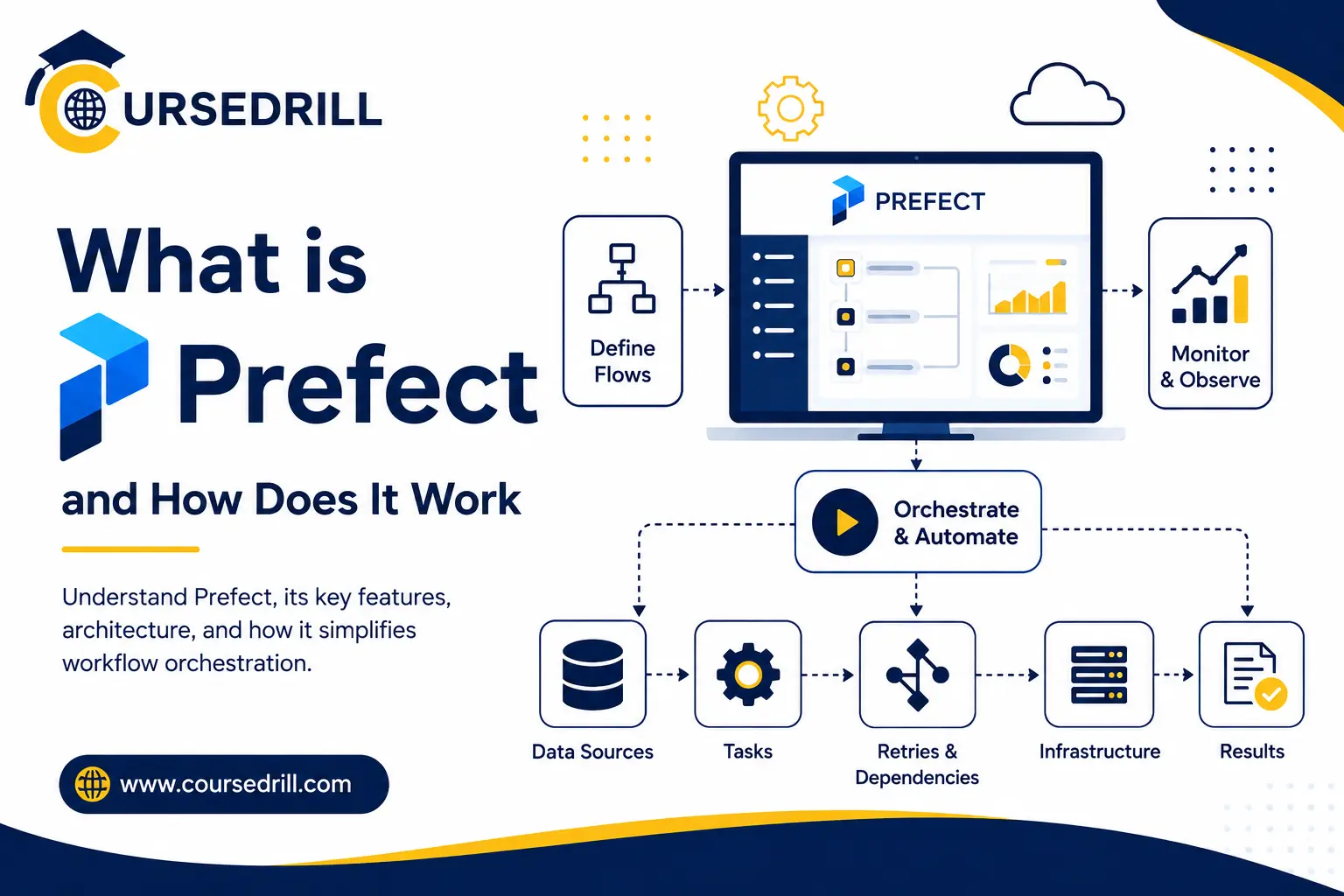
What is Prefect and How Does It Work?
What is Prefect? Learn how this Python-native workflow orchestration tool works, its core concepts, and how it compares to Airflow, Dagster, and Temporal.
If Python is already your team’s primary language and you’d rather not learn a new DSL, a YAML syntax, or a heavyweight scheduler just to automate a pipeline, Prefect is one of the first tools worth looking at. So what is Prefect, exactly, and how does it work under the hood? This guide walks through everything from the core concept to a working example, along with how it stacks up against the other orchestration tools you may have already come across.
What is Prefect?
Prefect is an open-source workflow orchestration framework built specifically for Python, designed to turn ordinary Python functions into scheduled, monitored, and fault-tolerant pipelines with minimal extra code. Where some orchestration tools ask you to learn a new definition language or restructure your code around a specific framework, Prefect’s core philosophy is to stay as close to plain Python as possible, adding orchestration behavior through decorators rather than requiring a rewrite.
Prefect’s team describes their broader mission around eliminating what they call “negative engineering”, the defensive, unglamorous code every data team ends up writing to handle retries, failures, timeouts, and logging around the actual business logic they care about. Instead of hand-rolling that infrastructure in every pipeline, Prefect provides it as a layer that wraps your existing Python functions.
The project has gone through a couple of major versions. Prefect 1.0 introduced the core ideas but required a more rigid, imperative style for defining pipelines. Prefect 2.0, and the current Prefect 3.x releases, moved to a far more flexible model where almost any Python code, including dynamic control flow, loops, and conditionals, can become part of a monitored, orchestrated pipeline just by adding a decorator.
The Problem Prefect Solves
To understand Prefect’s design choices, it helps to look at what data teams were dealing with before it, and what still frustrates them with some alternatives.
Writing a pipeline as a plain Python script is simple, until something fails. Does the whole script crash immediately? Do individual steps retry, and if so, how many times, with what backoff? How do you know exactly which step failed at 3 a.m. without SSHing into a server and grepping through logs? How do you re-run just the failed portion instead of the entire pipeline from scratch?
Traditional orchestration tools solve these problems but often introduce a real cost: a new definition language (as with Kestra’s YAML), a rigid DAG structure defined upfront (as with older Airflow patterns), or a steep learning curve around new abstractions.
Prefect’s answer is to keep the code you’d already write in Python, and layer orchestration on top through decorators. A function becomes a task. A function that calls other tasks becomes a flow. Almost nothing about how you’d normally structure Python code needs to change, which dramatically lowers the barrier for teams who are already comfortable in Python but don’t want to learn an entirely new framework’s mental model just to get retries and monitoring.
How Prefect Works: Core Architecture
Prefect’s architecture is built around a few key concepts, each mapping fairly directly onto how you’d already think about Python code.
Tasks
A task in Prefect is just a Python function decorated with @task. It represents a discrete unit of work, fetching data from an API, writing to a database, running a transformation. Tasks can have retries, caching, timeouts, and concurrency limits configured directly through the decorator, without any additional infrastructure code.
Flows
A flow is the orchestration layer, a Python function decorated with @flow that calls one or more tasks (and can also call other flows as subflows). Flows are where you’d define the actual sequence and logic of your pipeline, and because flows are just Python functions, you can use real loops, conditionals, and dynamic logic naturally, rather than working within the constraints of a static, predefined graph.
This is one of Prefect’s most distinctive design choices. Many orchestration tools require your pipeline’s structure to be knowable upfront, before execution, so the scheduler can build a static graph. Prefect instead allows the actual shape of a flow run to be determined dynamically at runtime, which matters for pipelines where the number of steps depends on data you don’t know until the pipeline is already running (processing a variable number of files, for instance).
Deployments
A deployment packages a flow along with its scheduling configuration, infrastructure requirements, and any parameters, making it something Prefect’s orchestration layer can trigger automatically rather than something you run manually from the command line. Deployments are what let a flow run on a schedule, in response to an event, or on demand from the UI or API, without you manually invoking the Python script yourself.
Work Pools and Workers
Work pools define where and how flow runs actually execute, a Kubernetes cluster, Docker containers, a local process, or various cloud compute options. Workers poll a work pool for scheduled flow runs and execute them in the appropriate environment. This separation lets you define a flow once and run it across different infrastructure without changing the flow’s code.
The Prefect API (Server or Cloud)
The Prefect API is the coordination layer, tracking flow run states, storing results, managing schedules, and serving the UI. You can run this yourself via Prefect’s open-source server, or use Prefect Cloud, the managed, hosted version. Notably, in Prefect’s architecture, your actual code and data still execute on your own infrastructure through your workers, even when using Prefect Cloud for orchestration and monitoring. Only the coordination and metadata layer is hosted; your business logic and data never need to leave your own environment.
Key Concepts You’ll Run Into
A handful of additional concepts show up constantly once you start building real pipelines with Prefect.
Retries can be configured per task with a simple parameter, @task(retries=3, retry_delay_seconds=10), without writing any manual retry loop yourself.
Caching lets a task skip re-execution if it’s already been run successfully with the same inputs, useful for expensive steps you don’t want to repeat unnecessarily during development or reruns.
Results are the return values of tasks and flows, which Prefect can persist to storage automatically, letting you inspect exactly what a given step produced after the fact, even for runs that happened days earlier.
Parameters let a flow accept inputs at runtime, similar to function arguments, so the same flow definition can behave differently depending on what’s passed in when it’s triggered.
Subflows are flows called from within other flows, letting you compose smaller, reusable pieces of logic into larger pipelines, the same way you’d compose regular Python functions.
Blocks are Prefect’s abstraction for storing and reusing configuration and credentials, database connections, cloud storage settings, API keys, defined once and referenced across multiple flows without duplicating configuration.
Automations let you trigger actions (sending a notification, kicking off another flow) in response to specific events, like a flow run failing or taking longer than expected.
A Simple Example of a Prefect Flow
Here’s what a basic pipeline looks like using Prefect’s decorator-based model:
from prefect import flow, task
import httpx

@task(retries=3, retry_delay_seconds=5)
def fetch_orders(url: str) -> list[dict]:
    response = httpx.get(url)
    response.raise_for_status()
    return response.json()

@task
def clean_orders(orders: list[dict]) -> list[dict]:
    return [order for order in orders if order["amount"] > 0]

@task
def summarize_by_region(orders: list[dict]) -> dict:
    summary = {}
    for order in orders:
        region = order["region"]
        summary[region] = summary.get(region, 0) + order["amount"]
    return summary

@flow(name="daily-order-summary")
def order_summary_flow(orders_url: str):
    raw_orders = fetch_orders(orders_url)
    cleaned = clean_orders(raw_orders)
    summary = summarize_by_region(cleaned)
    print(summary)
    return summary

if __name__ == "__main__":
    order_summary_flow("https://example.com/api/orders")
Notice how little of this looks different from a normal Python script you might have already written. The @task and @flow decorators are doing the heavy lifting: automatic retries on fetch_orders, state tracking for every step, and full observability into what ran and what it returned, all without writing any of that infrastructure yourself.
Running this script directly (python order_summary.py) executes it immediately, and Prefect tracks the run, its states, and its results even for this simple, un-deployed execution. To actually schedule it or trigger it automatically, you’d create a deployment:
from prefect import flow

if __name__ == "__main__":
    order_summary_flow.serve(
        name="daily-order-summary-deployment",
        cron="0 6 * * *",
        parameters={"orders_url": "https://example.com/api/orders"},
    )
The .serve() method registers this flow with Prefect’s orchestration layer and schedules it to run daily at 6 a.m., without needing a separate YAML configuration file or a different deployment tool.
Prefect’s UI and Observability
Prefect’s UI shows flow run history, task-level state transitions, logs, and timing for every execution. Each flow run has a visual representation showing every task that ran, whether it succeeded, failed, or retried, and how long each step took. Because tasks can run concurrently (Prefect supports async execution and concurrent task submission natively), the UI also shows you exactly how parallel steps overlapped during a given run, which is valuable for understanding bottlenecks in a pipeline with fan-out or fan-in steps.
Notifications and automations can be configured directly through the UI, alerting a Slack channel or triggering another flow when a run fails, exceeds an expected duration, or matches some other condition you define.
Prefect vs Other Orchestration Tools
Since Prefect enters a crowded space, here’s how it stacks up against the tools we’ve covered elsewhere on the site.
Prefect vs Airflow: Airflow requires DAGs to be statically defined upfront in Python, using its own operator abstractions. Prefect allows dynamic, native Python control flow, including loops and conditionals that determine a flow’s actual shape at runtime, without needing to know the full structure in advance. Airflow has a longer track record and larger plugin ecosystem; Prefect generally offers a gentler learning curve for teams already comfortable in plain Python.
Prefect vs Dagster: Dagster is asset-centric, built around the idea of tracking specific data outputs and their lineage across a pipeline. Prefect is more general-purpose and task/flow-centric, without a built-in concept of a persisted “asset” as the primary abstraction. Teams that care deeply about data asset lineage and testing may prefer Dagster; teams wanting maximum flexibility with minimal new concepts to learn on top of Python may prefer Prefect. Our Dagster tutorial for beginners covers that asset-first model in detail if you want the direct comparison.
Prefect vs Temporal: Temporal is built around durable execution for long-running, stateful business processes, with a strict determinism requirement for workflow code and a focus on reliability across very long time horizons (weeks or months). Prefect is more oriented toward typical data pipeline patterns, closer to traditional ETL and analytics workflows, with a lighter-weight execution model. Temporal’s guarantees around workflow replay and determinism are considerably stronger, but that strength comes with more rules about what you can and can’t do inside workflow code. Read our What is Temporal guide for the deeper technical comparison.
Prefect vs Kestra: Kestra defines workflows in YAML, prioritizing accessibility for non-Python users. Prefect stays entirely in Python, which is a better fit for teams who are already Python-first and don’t want to introduce a second definition language into their stack. Teams valuing broader accessibility across less technical stakeholders may prefer Kestra’s YAML approach; teams who are all-in on Python already may find Prefect feels more natural. See our What is Kestra guide for more on that side of the comparison.
Common Use Cases for Prefect
Prefect shows up across a range of typical data and automation workloads:
- ETL and ELT pipelines, extracting data from APIs or databases, transforming it, and loading it into a warehouse
- Machine learning pipelines, orchestrating training, evaluation, and deployment steps, particularly where the exact number of steps (models to train, datasets to evaluate) is dynamic
- Data quality and validation jobs, running scheduled checks against production data
- API integration workflows, pulling data from multiple third-party services on a schedule
- Notification and alerting pipelines, monitoring conditions and triggering downstream actions when thresholds are crossed
- General automation scripts that previously ran as plain cron jobs but need retries, monitoring, and a UI showing what actually happened
The common thread is teams already comfortable writing Python who want orchestration behavior (retries, scheduling, observability) without adopting a fundamentally different framework or definition language.
Prefect Cloud vs Self-Hosted
Similar to the other tools we’ve covered, Prefect offers both a self-hosted and a managed path.
Self-hosted Prefect runs the open-source Prefect server yourself, giving you full control over infrastructure and data. You still run your own workers to execute flows, but the coordination API, database, and UI are all under your own management.
Prefect Cloud is the managed, hosted version of the coordination layer, removing the operational burden of running the Prefect server and its database yourself. Notably, your actual flow code and data still run on your own infrastructure through workers you control; Prefect Cloud hosts only the orchestration metadata and scheduling layer, not your business logic or data itself. This hybrid model is a deliberate design choice, letting teams get the convenience of managed orchestration without needing to send sensitive data through a third party.
Benefits of Using Prefect
Pulling together what makes Prefect distinct:
Minimal new concepts for Python teams. If you already know Python, learning Prefect is mostly learning two decorators and a handful of configuration options, not an entirely new mental model.
Dynamic workflow structure. Native support for loops, conditionals, and runtime-determined pipeline shape, without needing to know the full structure of a run in advance.
Built-in retries and caching configured with simple decorator arguments, removing a large amount of boilerplate infrastructure code teams would otherwise write by hand.
Hybrid execution model. Prefect Cloud handles orchestration and monitoring while your code and data stay on your own infrastructure, a meaningful consideration for teams with data residency or compliance requirements.
Strong observability. The UI provides detailed, task-level visibility into every run, including concurrent task execution, without extra configuration.
Native async and concurrency support, letting flows run tasks in parallel using standard Python async patterns, rather than requiring a separate parallel execution framework.
Challenges and Things to Consider
Prefect isn’t without tradeoffs worth knowing about upfront.
Because flows allow dynamic, code-driven structure, they can be harder to statically visualize or reason about compared to tools with a fixed, declarative graph defined upfront. This flexibility is a strength for complex, data-dependent pipelines, but it also means less of the pipeline’s shape is knowable before it actually runs, which can matter for auditing or strict governance requirements.
Prefect’s plugin and integration ecosystem, while solid for common cloud services and databases, is younger than Airflow’s decade-plus of accumulated provider packages. Teams needing very niche or legacy system integrations may find more existing solutions in Airflow’s ecosystem.
Since Prefect stays close to plain Python, some of the stronger built-in guarantees other tools offer (Temporal’s strict determinism and replay guarantees, Dagster’s asset lineage tracking) aren’t part of Prefect’s core model in the same way. Teams needing those specific guarantees may find a different tool a better fit for that particular need, even if Prefect suits the rest of their orchestration needs well.
Getting Started with Prefect
For anyone wanting to try it hands-on, getting started is genuinely quick:
pip install prefectFrom there, decorating an existing Python function with @task and wrapping its caller with @flow is often all it takes to get a first working pipeline with retries and observability. Running prefect server start locally spins up the UI at http://localhost:4200, where you can watch your flow runs as they happen.
For teams wanting to skip self-hosting the server, signing up for Prefect Cloud and connecting a local worker is typically a five-minute process, giving you hosted orchestration and monitoring while your code and data remain on your own machine or infrastructure.
Testing Prefect Flows
Because tasks and flows are just Python functions under decorators, testing them follows patterns most Python developers already know. You can call a task or flow function directly in a test, the same way you’d test any other function:
def test_clean_orders_removes_invalid_amounts():
    raw = [{"amount": 10, "region": "west"}, {"amount": -5, "region": "east"}]
    result = clean_orders(raw)
    assert len(result) == 1
    assert result[0]["amount"] == 10
For cases where you want to test the full flow without triggering real retries, network calls, or external side effects, Prefect provides testing utilities that let you run flows in a synchronous, isolated test harness, and mock out specific tasks where needed. This keeps your test suite fast and independent of the actual Prefect server or any external infrastructure, similar to how you’d unit test any other piece of Python application code.
A Brief History: Prefect 1 vs Prefect 2 vs Prefect 3
Understanding a little of Prefect’s version history helps explain some of its current design decisions, and matters if you come across older tutorials or documentation while researching.
Prefect 1.0 introduced the original task and flow concepts but required flows to be built with a more rigid, imperative registration pattern, closer in spirit to how Airflow defines DAGs. Dynamic, runtime-determined pipeline structure wasn’t a core capability in this version.
Prefect 2.0 was a significant rewrite, introducing the fully dynamic model described throughout this guide, where flows are simply Python functions that can contain arbitrary control flow, and orchestration is layered on through decorators rather than a separate registration step. This version also introduced the modern deployment model and the hybrid execution architecture separating the orchestration API from where your code actually runs.
Prefect 3.x, the current generation, builds on the Prefect 2 foundation with further performance improvements, expanded automation capabilities, and refinements to the deployment and work pool system. If you’re starting fresh today, Prefect 3 is what you’ll be working with, and virtually all current documentation and tutorials, including this one, reflect that version’s patterns.
If you encounter an older tutorial referencing Flow() constructors or a separate registration step distinct from simply calling .serve(), it’s likely describing Prefect 1 patterns that no longer reflect how the current version works.
Prefect vs Celery
One more comparison worth a brief mention, since it comes up often for Python teams specifically: Celery is a distributed task queue, commonly used for background job processing (sending emails, processing uploads) rather than full pipeline orchestration. Celery doesn’t provide built-in scheduling, a monitoring UI, or the same concept of a multi-step flow with dependency tracking that Prefect does. Teams sometimes use Celery for simple, fire-and-forget background jobs while using Prefect for more structured, multi-step pipelines that need retries, observability, and scheduling as first-class features.
Frequently Asked Questions About Prefect
Is Prefect open source? Yes. Prefect’s core framework and server are open source, with Prefect Cloud as the separate, managed, paid offering for teams wanting hosted orchestration without running the server themselves.
Do I need to restructure my existing Python scripts to use Prefect? Usually not significantly. Adding @task to functions that do discrete units of work and @flow to the function that calls them is often enough to get orchestration, retries, and observability on an existing script with minimal changes.
Does Prefect require Docker or Kubernetes? No, not for basic use. Flows can run as local Python processes without any containerization. Docker and Kubernetes become relevant when you want to scale execution across more robust infrastructure, but they aren’t required to get started.
How is Prefect different from just using Python’s built-in retry logic and logging? Hand-rolled retry logic and logging work, but they need to be rebuilt and maintained separately for every pipeline. Prefect provides this behavior declaratively through decorators, along with a UI for observability, without you maintaining that infrastructure code yourself across dozens of scripts.
Can Prefect handle very long-running workflows, like Temporal does? Prefect can handle reasonably long-running flows, but it isn’t built around the same strict durable-execution guarantees Temporal provides for extremely long-running (weeks or months), stateful business processes. For that specific use case, Temporal’s model is generally the stronger fit.
Is Prefect a good choice for a small team or solo project? Yes, arguably one of its strengths. Because it adds orchestration through simple decorators rather than requiring new infrastructure or a new framework to learn, small teams and individual developers can get meaningful value (retries, scheduling, a UI) with very little setup investment.
Wrapping Up
So, what is Prefect, and how does it work, in a nutshell? It’s a Python-native orchestration framework that turns your existing functions into monitored, retried, and scheduled pipelines through two decorators, @task and @flow, without requiring a new definition language or a rigid, statically defined pipeline structure upfront.
For teams already comfortable in Python who want orchestration behavior without adopting an entirely new framework’s mental model, Prefect offers one of the lowest-friction paths available. It won’t replace Temporal’s durable execution guarantees for extremely long-running business processes, or Dagster’s asset lineage tracking for data-asset-heavy teams, but for general-purpose Python pipelines, ETL jobs, and automation scripts that need real retries and observability, it’s a genuinely practical choice.
If you’re comparing orchestration tools across the board, our guides on What is Temporal, What is Kestra, and our Dagster tutorial for beginners cover the other major players, and our Kestra vs Airflow comparison walks through another common head-to-head if you’re still narrowing down the right fit for your team.
For deeper technical reference as you build, the official Prefect documentation covers deployments, work pools, and Prefect Cloud configuration in more depth than a single overview article can.
Popular Courses